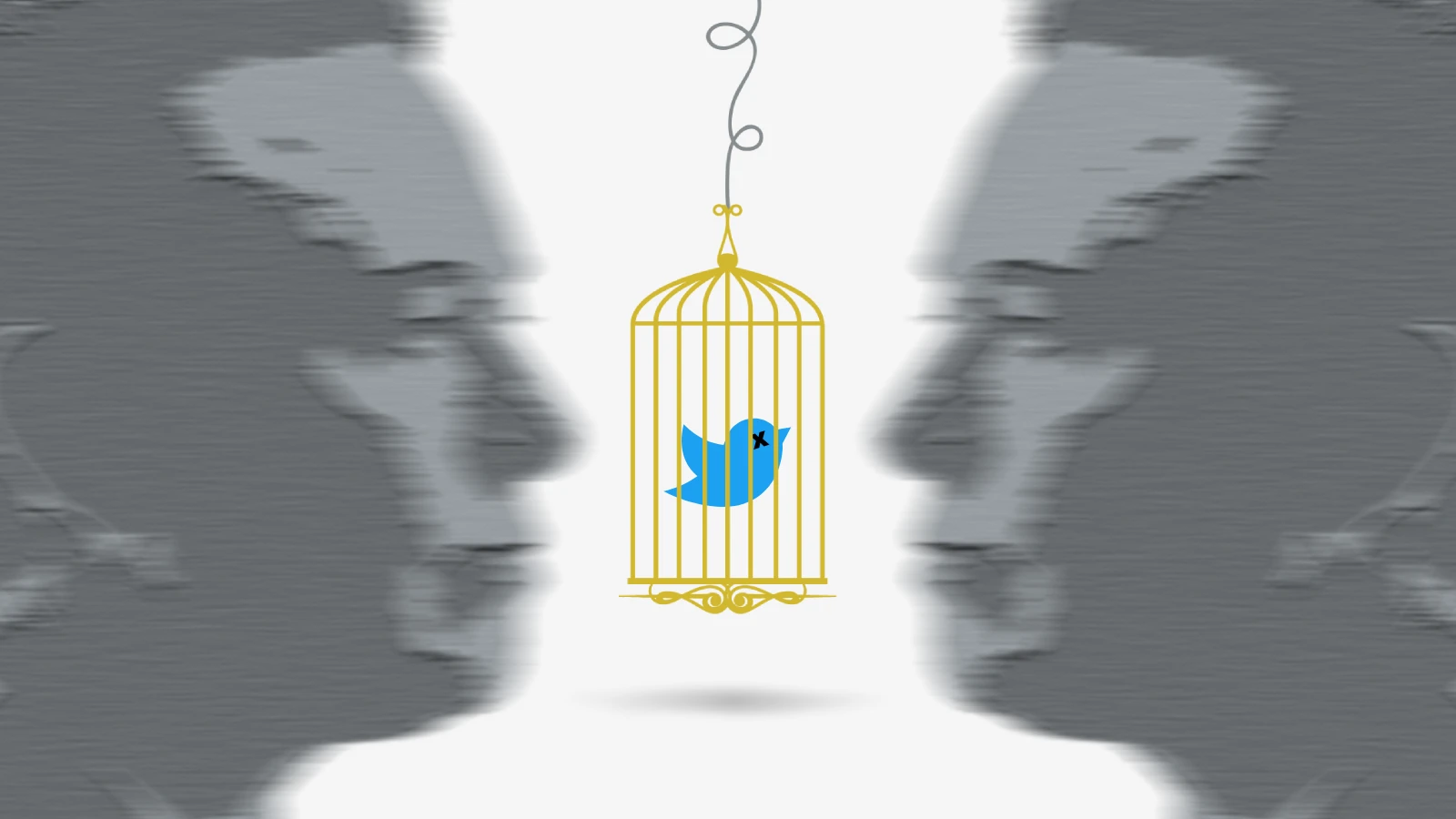
“Bülbülüm Altın Kafeste” (A Nightingale in a Golden Cage) is a beautiful piece of Turkish folk song. It tells the story of two lovers separated by longing. The voices of Erkan Oğur and İsmail Hakkı Demircioğlu add something entirely their own to it. You drift away somewhere distant, something stirs in you. The story, the words, the music — all of it carries a quiet sadness.
But today we’re not here to talk about the music or the lovers. We’re here to talk about the nightingale itself: the Twitter’s nightingale…
It’s probably fair to say that Elon Musk has been the most talked-about name in the world in recent years. Tesla, SpaceX, Neuralink, The Boring Company — each operating in a field that matters for the future. I follow what he does with genuine interest and respect.
But the reason Musk has been talked about so relentlessly of late is, as we all know, the Twitter acquisition. A process that began when Musk replied “How much?“ to a user who responded to his 2017 tweet “I love Twitter” with “Buy it then” — five years later, that became reality. (That tweet wasn’t the actual reason he bought it, of course. Or was it?)

The real chaos started after that. Mass layoffs of around 80% of existing staff, the removal of features that made Twitter what it was, and a stream of controversial new ones — we’ve witnessed fundamental changes on almost every front.
But it’s not just those things. There are also Musk’s own pronouncements that shape the news cycle, his posts that move markets (see: Dogecoin), his aggressive posture towards companies that paused advertising (see: Apple), and his actions that directly contradict the very freedom of expression he promised to champion. And more.
In short; Elon Musk has become our everything — our lives, our world, our leader of the century.
By now I think it’s fairly clear which direction this piece is heading. So let’s just get on with it…
Freedom Fighter, Our Glorious Elon
In November 2022, White House Press Secretary Karine Jean-Pierre issued a thinly veiled warning to Elon Musk following the Twitter acquisition. She made clear that the responsibility for tackling hate speech and misinformation lay with Twitter, and that the platform would be closely monitored.
On the subject of free speech in the US context: the First Amendment to the US Constitution — the one everyone points to — states that Congress shall make no law abridging freedom of speech or of the press. The key detail worth noting is that this law applies only to the government. In other words, no government-led censorship of any kind is permitted. Private companies are not subject to it.

“Congress shall make no law respecting an establishment of religion, or prohibiting the free exercise thereof; or abridging the freedom of speech, or of the press; or the right of the people peaceably to assemble, and to petition the Government for a redress of grievances.”
So the US government cannot penalise Twitter for acting against freedom of expression, because technically Twitter is not bound by the First Amendment.
Now, Musk’s own position on this…
About six months before buying Twitter, Musk argued that free speech should align with the law, and that he was opposed to censorship that went beyond what the law required. He said those who wanted less free speech should be knocking on the government’s door. In short, he said: “I’m a First Amendment man” — despite not being technically obliged to be.

This was, after all, one of the stated reasons he bought Twitter in the first place. He had described Twitter as the town square of the internet, and criticised the platform for being overly enthusiastic about censoring content. After the acquisition, he repeatedly spoke about supporting freedom of speech and expression, and the steps he intended to take in that direction. So it came as something of a surprise when, not long after, the spirit of those promises quietly evaporated.
While all of this was being debated, the new owner of Twitter — one of the wealthiest people on earth — became a symbol of free speech. A “freedom fighter” raising the flag of rebellion against governments and the establishment, tearing up the rulebook…
So what did our glorious freedom-fighting Elon actually do? Well, as always happens in these stories: “money first”.
Let’s take an example from a country we know well. Turkey. As you may know, Turkey has for years ranked near the top of the list of countries making the most requests to Twitter for user data and content removal — something we can verify through Twitter’s own Transparency Reports. Twitter, for its part, has historically rejected most of these requests on the grounds that the users or content in question don’t violate Twitter’s rules.
At this point I want to be clear: I don’t view Twitter as a platform with a perfect record on free speech. It has shortcomings and room to improve. But one of the things that made Twitter what it was, frankly, is that it held firmer against authoritarian governments than most other platforms, and didn’t shape its rules around what governments demanded. At least, that’s how it used to be.
Last May, right on the eve of the Turkish general election, something happened on Twitter that I’d never seen before. It may not have generated much international coverage, but for me it’s one of the clearest illustrations of how freedom of expression on Twitter has changed: the Turkish government submitted a content removal request to Twitter ahead of the presidential election, and this time Twitter complied. Why did it comply this time? See: the Elon Musk effect…
In its official statement, Twitter confirmed that access to certain content had been restricted in Turkey at the government’s request, and that the content in question would remain accessible in the rest of the world.
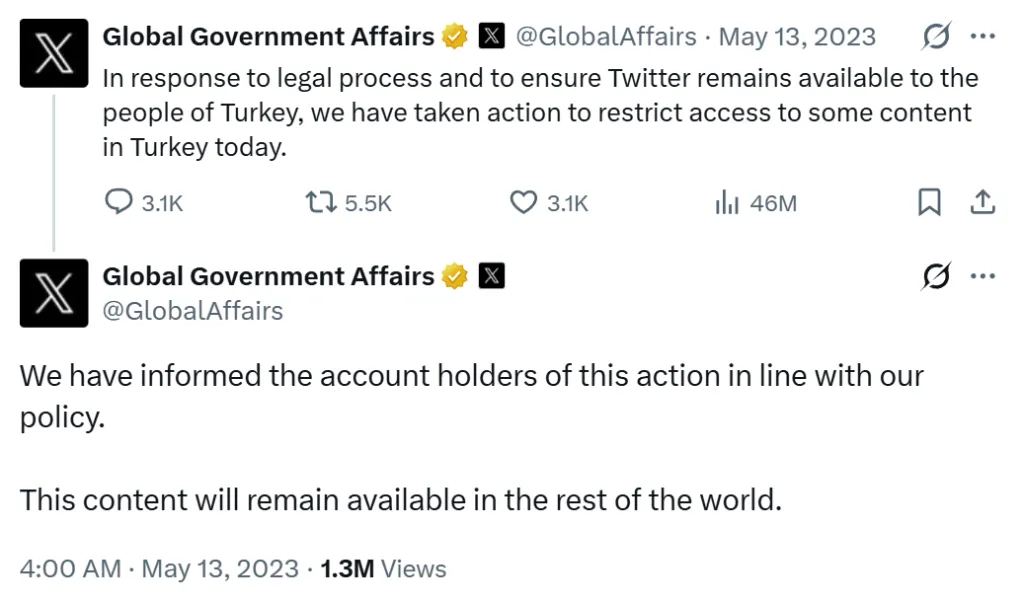
Users who noticed what had happened pushed back, naturally. One of them was Bloomberg columnist and free speech advocate Matthew Yglesias, who noted that the Turkish government had asked Twitter to censor its political opponents days before an election, and that Elon Musk had obliged.
Musk’s response to Yglesias has since become something of a classic:

“Did your brain fall out of your head, Yglesias? The choice is have Twitter throttled in its entirety or limit access to some tweets. Which one do you want?”
So our freedom-fighting Elon is arguing that censoring a few tweets is preferable to Twitter going dark in Turkey.
You’ve handed over users. You’ve made the compromise. What kind of free speech advocacy is this exactly?
For the record, I don’t know whether the tweets in question actually violated Twitter’s policies. They may well have. But from the official statement and Musk’s response, it’s clear the decision came down to a choice between Twitter being blocked entirely in Turkey or complying with the government’s request to suppress specific content. Whether those tweets violated Twitter’s policies wasn’t even part of the conversation.
Better to censor a few people than lose the market. That’s the maths.
Musk’s response brought a number of other free speech advocates into the conversation. One of them was Wikipedia founder Jimmy Wales:

“What Wikipedia did: we stood strong for our principles and fought to the Supreme Court of Turkey and won. This is what it means to treat freedom of expression as a principle rather than a slogan.”
A freedom fighter who uses freedom of expression as a slogan. Good one…
Would you like some extra freedom of expression for just $8 a month?
We’ve all watched the changes Musk has made to Twitter since the acquisition, and they keep coming. One of the most consequential has been the changes to the Twitter algorithm.
Twitter Blue was redesigned and a range of new features were bundled into the paid subscription. Fair enough — there’s nothing inherently wrong with that. But reconfiguring the algorithm to prioritise paying subscribers raises some uncomfortable questions about equality, fairness, and free expression.
If you’re a Twitter Blue subscriber — if you’re paying Twitter — you get more reach. Why? Because Twitter’s algorithm has been updated to show Blue subscribers’ posts to more people. Pay more, say more, be seen more, matter more.
Wasn’t the whole point of opening up the blue tick to everyone supposed to create a more level playing field? The lords & peasants system was “bullshit“, wasn’t it? Isn’t what we have now just a new tier of minor lords? Questions, questions…

Whether meaningful progress will ever be made on the free speech, fairness, and equality agenda Musk so frequently invokes remains to be seen. What’s clear is that in his very first year, he’s already failed the course.
All Twitter users are equal, but some Twitter users are more equal.
The bird has flown, winter has come…
Twitter is not Instagram, where you scroll through everyone’s suspiciously perfect lives. It’s not TikTok, where you watch people lip-sync. It’s not Facebook, where you catch up with relatives you’d rather not. And it’s certainly not LinkedIn, where you can enjoy an endless stream of career p*rn. Twitter is Trafalgar Square, Red Square, Times Square, Taksim Square. It’s the town square of internet, as Musk himself put it. Managing a public square of that kind — with its population density, its diversity, its economy, its safety concerns — is genuinely difficult. I have no doubt about that. But making fundamental changes to the structural features that made Twitter “Twitter” makes that difficult job significantly harder.
Twitter has a number of defining characteristics: the character limit, the ability to use the platform anonymously, relative freedom of speech (particularly significant in repressive countries), trending topics, real-time news, the ability to organise and amplify voices through hashtags, an algorithm that’s fairer than most, adult content (yes, this too is a reason some people choose it — it’s permitted), and more. These are some of the reasons users chose Twitter. Some are so embedded in the platform they’ve become symbolic; others address specific user needs. Changing them is risky. And the decision-making process around those changes should be painstaking, because tinkering with a platform’s foundations can anger users, push away advertisers, unsettle shareholders, and demoralise staff. But for Elon Musk, none of this seems to be much of a problem. “I decided, it’s happening” appears to be the operating philosophy.
Here’s a quick look at what’s been done and how it’s gone:
- $8/month for a blue tick: Anyone willing to pay gets verified. Real accounts and fake ones became indistinguishable. Scammers and disinformation peddlers thrived; impersonation accounts multiplied like weeds.
- Algorithm priority for Twitter Blue subscribers: Paying users became more visible, widening the inequality gap in who gets heard.
- 10,000-character limit (Twitter Blue): Long-form posts reminiscent of Facebook appeared. The art of saying a great deal in very few words — one of Twitter’s defining skills — began to erode.
- Algorithm metrics made (partially) public: Once people knew what the algorithm rewarded, posts began to converge around those signals. Everything started to look the same.
- Moderation teams largely gutted: Trending topics became a wasteland. The question “why is this trending?” became unanswerable. Abuse increased; content reporting became largely pointless.
- Links in tweets deprioritised by the algorithm: News sharing dropped. The ability to follow breaking news — one of Twitter’s core functions — was quietly diminished.
- Tweets made inaccessible to logged-out users (later reversed): Public tweets disappeared from Google results. Off-platform sharing fell. Twitter traffic dropped significantly.
- The iconic Twitter bird logo and name replaced with “X”: I’ll leave the commentary on this one to you.
These are the changes I’ve experienced firsthand as an active user, and the consequences I’ve observed. How are these decisions being made? Is no one asking what’s happening and why? I can’t answer that fully, but let me try to address part of it. The subject: expertise, crowds, and democracy.
The Tyranny of the Crowd
Democracy is a good thing. It’s not a perfect thing. In societies with low levels of education, for instance, democracy doesn’t function well — which increases the risk of democracy producing the very authoritarianism it’s meant to prevent. A healthy democracy requires a certain baseline of civic knowledge and critical thinking. Without it, you end up living according to the preferences of a manipulated — or manipulating — population. “What does any of this have to do with Twitter?” you might ask. Quite a lot, as it turns out, in the post-Elon era.
One thing Musk has emphasised repeatedly since the acquisition is the idea of governing for the people, by the people. Faithful to this philosophy, he’s consulted Twitter users on a number of significant decisions, putting them to a vote. “Your voice, your choice”, he said. Asking people what they think, putting it to a vote, acting on the result. That’s democracy. That’s governance. How wonderful, isn’t it?
Isn’t it?
No. Take a population that lacks expertise on the question being asked, add everyone with a strong opinion and no relevant knowledge, throw in the Twitter noise machine at full volume — and, most importantly, add bot accounts. Congratulations! You now have a perfectly legitimate deadlock, and the people’s champion is well on his way to becoming a digital dictator.
Crowdsourcing decisions that require genuine expertise is one thing. Acting on those crowd responses is another. Especially when the crowd in question is Twitter’s general population, who have strong opinions on absolutely everything.
Musk, who has invoked Vox Populi, Vox Dei (the voice of the people is the voice of God) has used this approach many times, taking shelter behind the idea that users’ decisions are users’ decisions, nothing to do with him. One of the most prominent examples was the Donald Trump question. In 2021, Twitter had permanently suspended Trump’s account citing incitement to violence and violations of its policies. Musk put the reinstatement to a user poll. Fifteen million people participated; 51.8% voted to restore the account. Musk reinstated it accordingly.

The issue here isn’t whether Trump’s suspension was justified or whether his behaviour violated Twitter’s policies. The issue is that this decision was put to a public vote and determined by its outcome. On what basis were people voting? Would a meaningful result emerge from that process? And — most importantly — would this democratic approach apply equally to every other banned account? If not, what made Trump’s case special? If yes, why did the People’s Champion refuse to reinstate American broadcaster and conspiracy theorist Alex Jones, and why was there no poll for that?

And putting platform-wide feature decisions to a vote raises the same problems. Should tweet editing be introduced? Should Vine come back? What features do you want on Twitter? Getting user feedback is fine and sensible. Saying “we’ll implement whatever gets the most votes” on a platform swimming in bot accounts is not.
Having fully leaned into the People’s Champion role, Musk eventually took it one step further and asked users whether he should step down as CEO. He said he’d abide by the result. This time, though, things didn’t go as planned. Seventeen million people participated, and 57.5% said: yes, step down!

The backpedalling began almost immediately. Musk, who normally tweets at an extraordinary rate, went uncharacteristically quiet. He then threw his support behind claims that bots had participated in the poll and manipulated the result. Under mounting pressure, he eventually said he would leave once a suitable replacement was found. But if bots can manipulate this poll, what stops them from having manipulated every other one? At some point you have to ask: was any of this ever really about the people?
The cult of Elon and his true believers
If you’ve spent any time on Twitter, you’ve encountered the devoted followers of various figures — people who defend their chosen leader with an almost religious fervour, for whom criticism of that person is not just wrong but a personal affront. Andrew Tate’s disciples, Trump’s army, the political party faithful who treat their platform as sacred ground. We now have a version of this for Elon Musk.
Dare to criticise our glorious Elon? Sharpen the swords, heads must roll. What’s the criticism about? Irrelevant. He’s the people’s champion, the rule-breaker, the architect of our future. Whatever he says is right.
Part of what keeps Musk permanently in the news cycle is the public persona he’s constructed for himself. Another part is the fact that his tweets were being actively prioritised in everyone’s feeds — meaning every time you opened Twitter, there was Elon. When users noticed and complaints mounted, he initially laughed it off, then said it would be fixed.

Then there’s the fact that Musk responds to ordinary users, which has created a peculiar dynamic. Users hoping for a reply began flooding his mentions constantly. His defenders grew more vocal; his critics were targeted and pile-ons became routine. A strange interest-driven cult of personality formed around him.
Entire articles and news features were written about this phenomenon alone. The group even acquired a name: the Musketeers. True believers convinced that this man is going to save the world.
So consider yourself warned: if you’re thinking of criticising our glorious Elon on Twitter, think twice. Getting caught between the “it’s his platform, he can do what he wants” crowd and the Musketeer is not a comfortable place to be.
The search for an alternative, and Instagram v2
So what are users like me — who actually care about what Twitter was — supposed to do beyond expressing frustration? Those unhappy with where Twitter has ended up have been looking for alternatives, and that’s been visible. But how much of an alternative are any of them?
One option that emerged was Mastodon. An open-source platform, Mastodon hosts thousands of separate social networks running on different servers. And that’s exactly the problem: thousands of options to drown in. Asking users to adopt this kind of complexity at a moment when everything else is moving towards simplicity makes no sense. The interface is poor, the system is confusing, and even the names given to its various components seem to float in mid-air. Move along.
Bluesky was perhaps the platform that gave the most hope to Twitter refugees. It has Jack Dorsey — Twitter’s own founder — behind it, and it’s built on a decentralised open-source architecture that’s genuinely innovative. And yet. Like so many platforms in their early stages, it launched on an invite-only basis. Two full years later, nothing meaningful has changed. Bluesky became a platform where potential users are left begging for invitations. What happens further down the line remains to be seen. But for now: move along.
Which brings us to the alternative that generated the most noise. Threads, launched by Meta through Instagram. With Twitter in its death spiral, Mastodon falling short, and Bluesky stuck in perpetual beta, Mark Zuckerberg spotted an opportunity and launched Threads as the closest like-for-like Twitter alternative on the market.
It reached 100 million users in just four days. Remarkable, isn’t it?
Isn’t it?
No. Because Threads reaching those numbers so quickly wasn’t the result of organic growth — it was the result of a structural advantage. As you’ll know, signing up for Threads requires an Instagram account. Threads is embedded within Instagram. That means Instagram’s existing user base can migrate to Threads in seconds. A neat little trick.
Same user base as Instagram. Same user data. Same algorithm. So in what sense is Threads a Twitter alternative?
On a genuinely new platform, where everyone starts from zero, visibility is up for grabs. That’s part of the appeal. Everyone has a chance to grow. On Threads, however, that supposed fresh start only benefited those who were already powerful on Instagram. Accounts with millions of followers made a grand entrance. Everyone else stayed exactly where they were.
The result: Twitter-famous users talked down Threads; Instagram-famous users championed it. Everyone interpreted the situation however suited them best.
In short: Threads set out to be a Twitter alternative and arrived as Instagram v2 with a Twitter skin. Move along.
It’s also worth noting that changing user habits is not straightforward — I’ve written about this in “You Have a Notification! – The Attention Industry and Our Habits“. Getting users to make the switch requires some real pushing. Current alternatives don’t appear capable of doing that pulling; what seems more likely is that Twitter will do the pushing.
Maybe a bird will pass over us ♪*
Our glorious Elon wants to transform Twitter — under the “X” brand — into an everything app, something in the vein of WeChat. Whether that everything app ends up as one of those tourist-trap gift shops where everything is overpriced and underwhelming but technically caters to everyone, or whether it genuinely does something no one has managed before, time will tell.
But contrary to what his disciples might say, watching Twitter and Twitter culture slip into a vegetative state at Elon Musk’s hands genuinely saddens me. Because the Twitter we knew was — compared to other platforms — one that stood firmer against repressive governments, that was more generous with freedom of expression despite its flaws, more open, more alive, more real.
Maybe Twitter’s nightingale really does die, and rises again from the ashes like a phoenix. Maybe Elon Musk saves the world [laughs]. Maybe a bird will pass over us ♪… Who knows…
*Belki Üstümüzden Bir Kuş Geçer (Maybe a Bird Will Pass Over Us) is a popular song by Yüksek Sadakat, a Turkish rock band.