
As technology has advanced, so have our habits, hobbies, and the way we see the world. Our entire way of life has shifted. Communication itself is one of the concepts that has changed and transformed through this process.
Every communication medium that technology has introduced — television, radio, computers, the internet, and with it email, websites, social media platforms and instant messaging apps — has caused the concept of communication to be redefined each time.
So do these new communication tools that we all use every day, as products of a changing and evolving technological world, actually create a change in communication itself?
As Canadian philosopher and writer Marshall McLuhan explored in his 1967 book The Medium Is The Message, which examines the relationship between content and medium in communication — are our communication tools disrupting communication itself and leading us towards a state of non-communication?

Note: The original title of the book is actually “The Medium Is The Massage”. The word “Massage” was later changed to “Message,” but McLuhan himself preferred the version with the typo, which had arisen from a printing error.
The relationship between medium and content in communication
When you want to share something about a TV series you’re watching, which platform would you use? Or say you’re out and about and you’ve taken a great photo on your phone and want to show it to your friends. What method would you use?
We’re all witnessing the change and transformation that communication has undergone alongside technological development. But if we set aside the sociological and psychological dimensions for a moment, we can say that communication technically involves two important concepts: Medium and Content.
Marshall McLuhan, known particularly for his work on media theory, examined this subject in depth and produced work fifty years ago that feels remarkably prescient today. In his research, he focused especially on the evolution of communication and its effect on communication itself, addressing it through these two concepts — content and medium — in The Medium Is The Message.
McLuhan draws attention to the way that technologically-driven changes in how we communicate disrupt communication itself. In short, he argues that the way we communicate (the medium) matters more than what we communicate (the content).
“Any understanding of social and cultural change is impossible without a knowledge of the way media work as environments.” — Marshall McLuhan
From consuming information to producing it
Thinking about this in technological terms: years ago, television and radio were the producers, and we were the consumers of the information they broadcast. As consumers, we could only passively receive the limited information those outlets chose to give us, in one direction only. But from the 21st century onwards, technological development has placed us not just in the role of information consumers, but information producers as well. The shift from traditional media to new media also diversified the sources of information themselves.

For example, while watching a TV series (as a consumer), we can simultaneously communicate and interact with people anywhere in the world who are watching the same thing (as producers) — even with the actors in the series themselves.
Artists, politicians or writers we couldn’t have imagined reaching just a short while ago are now just a message away. A single tweet can send a notification to their phone. In short, we’re benefiting from the shift from one-way communication to multi-directional communication.
The impact of communication tools at a societal scale
Beyond their effect on individuals, communication tools can have serious consequences at a societal level too. Looking at examples that have spread across entire societies gives us an even clearer picture of where communication has arrived.
The Arab Spring, which began in Tunisia in 2010 and spread to other Arab countries, reached huge numbers of people largely through the way individuals organised on social media platforms. Some governments, caught off guard by this, resorted to censorship and restrictions, while others chose to shut down the internet entirely. But this produced a Streisand effect, causing the protests to grow to an even larger scale.

The Gezi Park events that began in Istanbul in 2013 and spread across the country similarly showed us the kind of impact social media can have at a societal level. When news restrictions were imposed on broadcast outlets that could reach large audiences, people turned to social media platforms to communicate and organise more “freely”. Twitter in particular became the most effective communication tool during those events. Restricting internet access and blocking platforms like Twitter and YouTube produced, again as with the Arab Spring, a Streisand effect that caused things to escalate further.

As we can see, social media platforms that everyone assumes are used for something as innocent as “socialising” can have a profound effect on entire societies. Someone can rise to prominence overnight — or be thoroughly disgraced — and that impact can be felt at a societal scale.
Attention spans are shrinking, memory is weakening
The fact that everyone can now produce information, and the resulting diversification of communication platforms, is also causing those tools to overtake communication itself. In this context, it’s worth acknowledging that making communication and access this easy has some side effects.
According to a study conducted by major universities including Oxford, King’s College London, Harvard and Western Sydney University, there is a negative correlation between internet and technology use and human memory. In other words, the more technology and the internet occupy our lives, the shorter our attention spans become and the more our memory weakens. This leads us to take the easier route when communicating.

At the end of the day, we tweet in 280 characters, shoot one-minute Instagram videos, and pack a whole range of words into a single emoji.
In short, as communication technologies develop, the human brain gravitates towards what is easiest — and that in turn drives the development of communication technologies that make it easier to communicate. If you take a step or two back and look at the bigger picture, you can see that this has also become a cycle.
The same study also notes that this situation may have a positive side in the future. If the internet comes to function as a kind of external memory, it’s thought that the human brain could free itself up for other activities and work more efficiently as a result.
Communication in its simplest form: Emojis
With social media and instant messaging platforms now fully integrated into our lives, emojis have taken our communication experience to a different level altogether. Expressions that once required several words can now be conveyed with a single emoji.
In other words, since language barriers don’t apply either, it’s become possible to describe emojis as the world’s shared, universal language.
This is actually precisely where the human brain’s tendency to gravitate towards ease shows itself most clearly. The reason emojis are used so widely and so frequently is, we could say, that same impulse towards taking the “easy route”.
As I’ve mentioned in previous posts on this topic, it’s worth remembering that emoji use can still cause some communication problems.
See: Emojis in Communication: What They Mean and Where It All Goes Wrong
As shown in the image below, a single emoji can appear differently across different platforms. This means the feeling the sender intended to convey can end up being interpreted quite differently by the person receiving it.
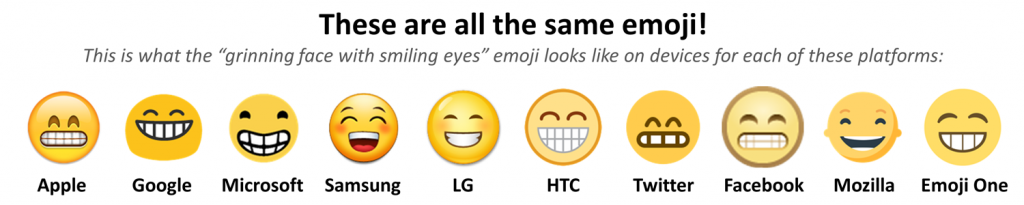
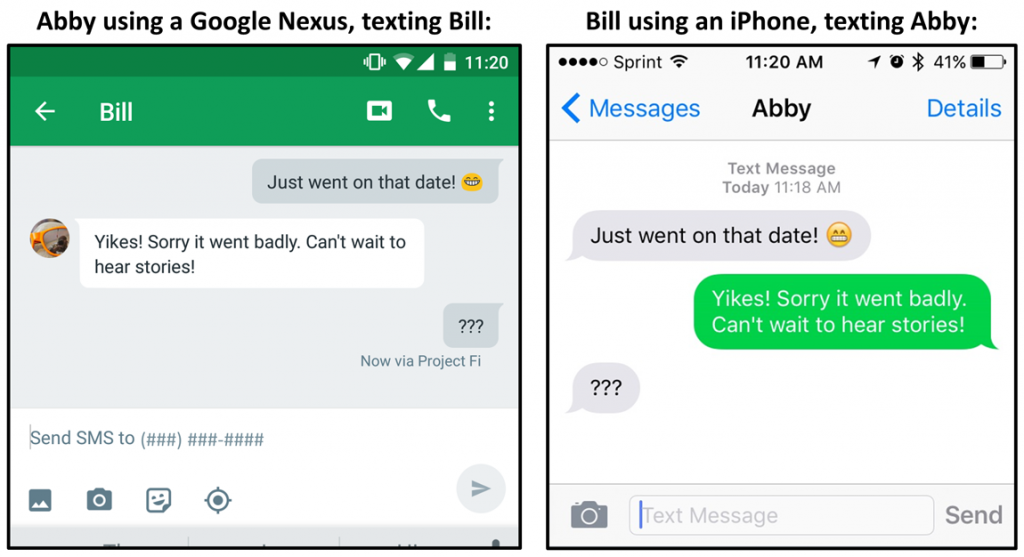
In short, the medium through which someone receives a message matters just as much as the emotion the message is meant to carry. The example below illustrates this effect of the same emoji across different platforms more clearly.
Conclusion
When we reflect again on communication technologies, on how the medium of communication shapes communication itself, and on the power these mediums have to spread through entire societies — we can say that we are now living through the vision McLuhan laid out roughly fifty years ago. As he argued repeatedly in his book, the way we communicate has become more important than what we communicate.
Let’s close with the words of French director Jean-Luc Godard, which neatly summarise where communication stands today:
“Communication is no more; there are only communication tools.” — Jean-Luc Godard
Sources: The Medium Is The Message – Marshall McLuhan (Book), The “online brain”: how the Internet may be changing our cognition, Varying Interpretations of Emoji – GroupLens Research