
Note: This post is translated from the original Turkish. The examples used are specific to Türkiye and the Turkish digital landscape, but the underlying issues around SEO ethics apply broadly.
Every brand has its own digital marketing strategy, or at least believes it does, built around fairly universal goals: reaching more people, driving more sales, building brand awareness, getting its message out to a wider audience.
When you consider that most of us now turn to search engines like Google as our default starting point for any information, it’s fair to say that search engine optimisation (SEO) occupies a pretty significant place in any digital marketing strategy.
Note: I won’t go into detail on what SEO actually is here. A simple Google search will give you more than enough to get started.
We all know that SEO has become almost synonymous with Google at this point. You only have to look at its market share to understand why: as of April 2020, Google holds 86% of the global search engine market. That makes it the most valuable playing field in SEO by some distance, and most brands orient their SEO efforts almost entirely around Google as a result (in fact, a large majority do exclusively Google-focused SEO).

So what does Google actually look for when deciding which pages rank where? What metrics does it use, and how often does it update them?
Google has made some of its criteria public, and some it hasn’t. The total number of known ranking factors is estimated to be well over 250. These include things like heading tag hierarchy, domain age, keywords, mobile compatibility, page load speed, image usage, code structure, content originality and consistency, backlinks, sitemap structure, and time spent on page, among many others.
Back when search results were largely static, following these metrics closely gave you a reasonable shot at ranking for your target keywords. SEO had a formula, and if you followed the formula, you could generally get the results you wanted. But we’re no longer in the static era. We’re now in the dynamic, real-time SEO era. And that means the whole thing is considerably more complex.
When I say complex, what I really mean is personalised. When someone runs a search, they no longer see the same results as everyone else. They see results tailored to their own behaviour and history. Social media activity, location, device usage, time of day, browsing history — essentially any trace a user leaves online — can now be factored into Google’s AI-driven search engine. The result is a personalised set of search results for every user.
So what does that mean?
The metrics that drove results in the static era still have some technical relevance, a good portion of them anyway. But the idea of targeting a specific keyword and aiming to rank first for it is increasingly losing its meaning. In a world where everyone sees personalised results, talking about rankings in absolute terms makes less and less sense.
The real focus, then, should be on the things that don’t lose their relevance: completing the necessary technical groundwork (site speed, image optimisation, code structure and so on) and then building on top of that with the metrics that hold their value over time.
And on this point, Google, the very company that built and essentially is this system, has been saying the same thing for years: think about your users.
SEO work should be done for users, not for Google. A user-first approach to SEO feeds back into your results in very tangible ways: longer time on page, lower bounce rates, stronger social signals. The outputs take care of themselves when you focus on the right input.
Now, let’s get into what the “good, bad and ugly” framing in the title is actually about. I’m not going to attempt a full technical SEO audit of the sites I mention. This is more about what I think is right and wrong, from both a general and an ethical standpoint.
The good SEO
“Good SEO”, as I’d define it, is where the technical groundwork is in place based on known (and suspected) ranking metrics, and where the user experience is built on top of that foundation rather than the other way around.
In other words: setting your strategy around a user-first approach rather than just optimising for search bots, staying within the boundaries of your own sector, maintaining consistency, and meeting technical SEO requirements along the way. That’s what it means to do SEO properly.
One brand that has caught my attention recently for doing exactly this is Medical Park, a private hospital group in Turkey.
Note: I have absolutely no idea which agency or individual handles Medical Park’s digital marketing or SEO. Just to be clear.
Medical Park produces content around health topics people are actively searching for and presents that content in a user-friendly page structure. Search for something they’ve written about, and they tend to show up near the top.
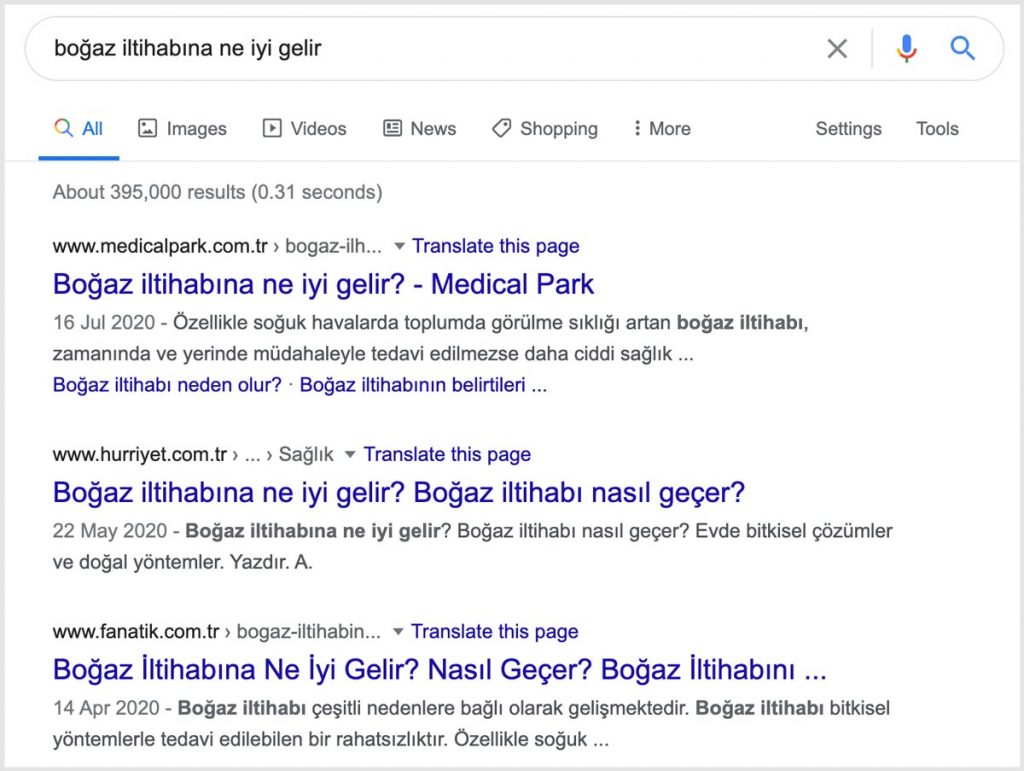
Setting technical details aside, two things stand out: their content is directly relevant to their sector, and it actually answers the question being asked rather than dancing around it.

The process, in short, goes like this: I want to find out about something health-related. I search for it. A website belonging to an actual healthcare provider appears. I visit it. I get a genuinely useful answer.
That’s all any user actually wants. And when the subject is something as important as health, the trust dimension of that becomes even more significant.
The bad SEO
When I think of “bad” and “SEO” in the same sentence, my mind immediately goes to government and institutional websites in Turkey. With a few exceptions, I don’t think the majority of them have any real intention of doing good SEO work. In theory, perhaps. In practice, definitely not.
I could pick almost any of them as an example, they all shine in their own special way 🙂 But if I had to choose just one, I’d go with the Turkish Language Association (Türk Dil Kurumu / TDK), which is the official authority on Turkish language and spelling rules.
Basic grammar and spelling rules that people search for every single day still can’t be reliably learned from the official source. Even when people specifically add “tdk” to their search (e.g. “how do you write ‘herşey’ tdk”), the TDK’s own page often doesn’t appear in the results.
The chart below shows Google search volume data for the phrase “herşey nasıl yazılır” (“how do you write ‘everything’”) between 2005 and 2020. These searches aren’t going away. They’re increasing. Given that Google is now the default starting point for almost everything, TDK has a genuine responsibility to make sure accurate Turkish spelling and grammar guidance is actually findable.
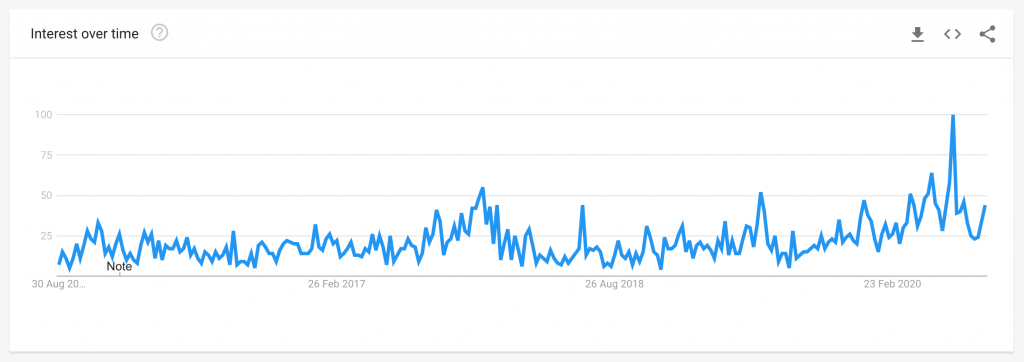
Note: For the record, the correct spelling is “her şey” (two words).
This isn’t a problem unique to TDK. Many institutional websites in Turkey share the same issue. At a time when the internet is already swimming in misinformation, public institutions should be doing their part to make sure people can actually find accurate information.
The ugly SEO
Good SEO, bad SEO, fine. But what is “ugly SEO”? This is actually the section I most wanted to write. Because this is where SEO crosses into ethics and integrity. You might wonder what ethics has to do with SEO, but as with anything else, there are unwritten rules that should be followed, and written rules that get conveniently ignored.
For sites doing good SEO, there’s nothing to say except well done. For sites doing bad SEO, you can offer advice, suggest fixes, help them improve. But for sites doing ugly SEO? There’s rather a lot to say.
First, we need to acknowledge a real problem in Turkey’s digital landscape: a deeply ingrained obsession with traffic above all else. Across almost every sector, almost every website is chasing the same thing, regardless of consequences: more traffic. I call these sites “traffic monsters“.
When I talked about good SEO earlier, I mentioned the importance of knowing your boundaries: staying within your sector benefits you and also leaves room for everyone else trying to get traffic from legitimate searches. Everyone should play in their own garden, so to speak. When they don’t, you get unfair competition.
Here’s an example that appeared on Twitter a few times recently and stuck with me:
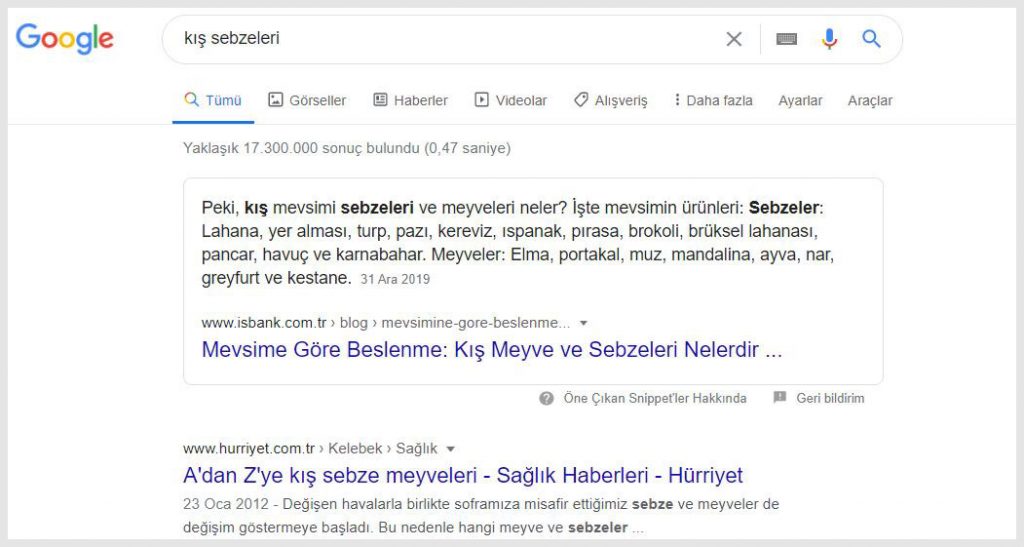
Lovely, isn’t it? İş Bankası (a major Turkish bank) ranking first for “kış sebzeleri” (“winter vegetables” in Turkish). Outstanding SEO work. A masterclass in digital marketing. A genuine success story. Or is it? Is this really what SEO is supposed to be?
To be technically accurate, I should clarify something. What İş Bankası did here is, technically speaking, an SEO effort. It could even be called an SEO success on paper.
But SEO isn’t just a formulaic technical exercise. It’s a significant part of the broader digital marketing process, and it needs to be looked at as a whole.
I mentioned earlier that content and SEO should be produced for users, not for search bots. Let’s keep that in mind and come back to the İş Bankası example.
Imagine İş Bankası had tried to share this “winter vegetables” content on their social media channels. How do you think people would have reacted? A bank posting about winter vegetables. “What on earth?” would be the polite version. Could they share it? No. Should they try? By all means, let’s see how that goes 🙂
In short, when content is produced not for users but purely for search engines, purely to capture traffic, the brand’s identity takes the hit. And there are other consequences too.
Beyond the brand damage, there’s a clear case of unfair competition here. İş Bankası’s “ugly SEO” play, amplified by the strength of its domain authority, pushes it to the top of results it has no business being in, effectively blocking traffic that rightfully belongs to websites that actually operate in health, nutrition and food content.
Some will say: “It’s an open playing field, anyone can put in the work and rank.” But a competitive environment only works when the conditions are fair and the players follow the rules. Take a look at the antitrust cases brought against Google, Amazon, Facebook and Apple, and who’s won them. That should give some context (perhaps a topic for another post).
İş Bankası is just one example. As I said: everyone should play in their own garden. But what about companies that claim every sector is their garden? Yes, I’m talking about news sites.
“Watch now, stream free, full HD…”
News sites are, in my view, one of the more embarrassing features of Turkey’s digital landscape, and they sit comfortably at the top of this list. They take whatever advantages they have and turn them into tools for manipulation without a second thought: misleading headlines, fabricated stories presented as fact, cheap tricks to harvest clicks, and much more.
Take the search example below. Look at the search term, the result category, and what’s actually in those results. In the Bad SEO section earlier, I used the TDK example and searched for “nasıl yazılır” (“how do you spell”). Here I’ve done something similar but filtered the results to show only “News” content.
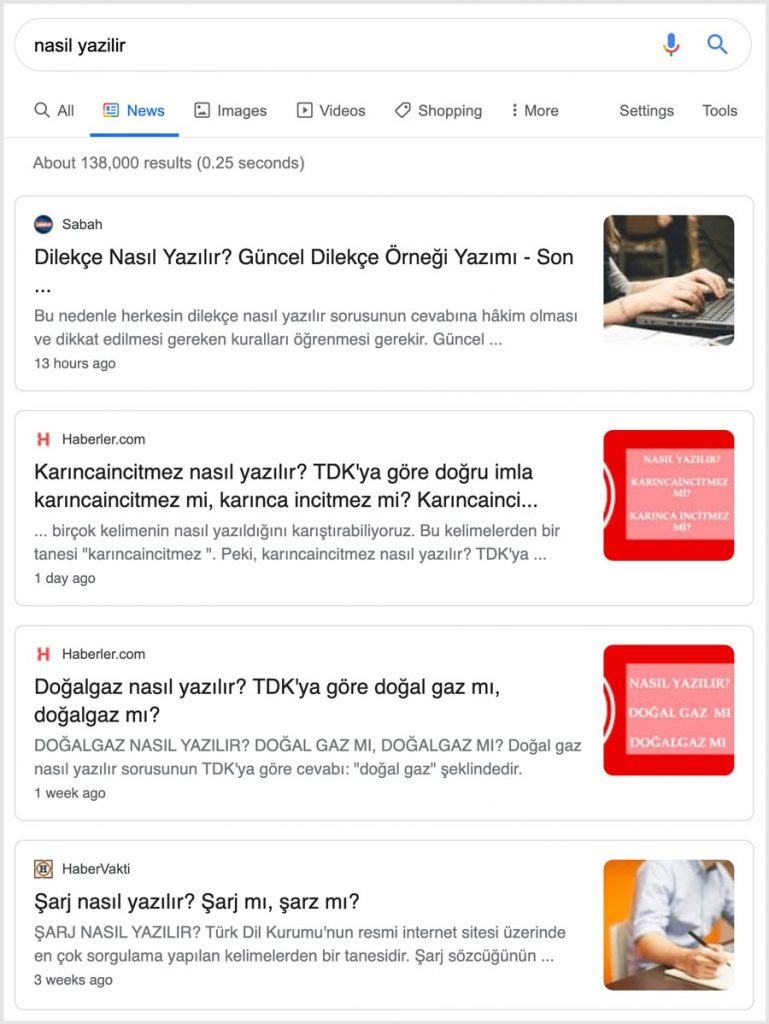
According to Google, these are news articles. Prioritised content, flagged as news. So when someone runs this search, they’re shown these results first because the sites producing them have Google News registration. And our finest news sites are very happily exploiting that registration to hoover up traffic they have absolutely no business receiving. Being news organisations apparently gives them a sense of entitlement to cover every topic under the sun.
Where is Google in all of this?
It’s fair to say that Google’s scrutiny of Turkish search results has not always been particularly rigorous. The degree of comfort news sites operate with here is partly a result of that. That said, looking back, there have been moments when Google has stepped in.
Some of you may remember 2014, which was a significant year on this front. A large number of Turkish news sites were hit hard by Google after being flagged for misleading users through exactly the kind of SEO manipulation described above. Google removed these sites’ pages from search results entirely and informed them that the content would remain delisted until all spam pages were removed.

Major outlets including Milliyet, Hürriyet, Habertürk, CNN Türk, Radikal, Akşam, Star and Bugün all had their search results wiped for a period. With Google being their primary traffic source, they had little choice but to comply. In short, Google gave Turkish news sites a very firm talking-to and issued an ultimatum. They listened, for a while.
Another example from 2016: at the time, Google was giving preferential ranking treatment to pages that contained video. NTV decided to use this to their advantage and began marking pages as containing video when they did not, purely to rank higher in search results.

After user complaints and Google’s intervention, NTV was forced to drop the tactic and correct the affected pages.
At the end of the day, while Google has stepped in at various points to address this kind of behaviour, it clearly hasn’t been enough to change habits. The traffic monsters are still at full speed, fighting for every click through unfair means.
Conclusion
To wrap up: SEO is about considerably more than ticking technical boxes. Google search, which is the primary gateway through which most internet users find information, can be turned into a junkyard through exactly this kind of manipulation.
From a user perspective, what matters is finding the right information, in the right place, at the right time. That’s a simple thing to want, and it’s being undermined. From a competitive perspective, the unfairness here is significant and shouldn’t be glossed over.