
Note: This post is translated from the original Turkish. Some examples and cultural references are specific to Türkiye, but the broader points about digital habits and data privacy apply universally.
The human brain always gravitates towards what is easy. Giving up any activity that has become a habit is hard precisely because of this. The brain doesn’t like change, doesn’t want the unknown. Even when what’s at stake is the person’s own values, information or data, the outcome is usually the same.
The most current example of this can be seen in the social networks and modern communication tools that now occupy such a central place in our lives. The reason WhatsApp has dominated the news cycle recently fits neatly into this same frame.
“Like it or lump it”
So what actually happened? Why did WhatsApp and its alternatives suddenly fill every conversation? It all started when WhatsApp felt the need to update its Privacy Policy. The updated terms informed users, in short, that WhatsApp would now be able to share user data with all companies under the Facebook umbrella, and that those companies could use the collected data for their own purposes: improving services, personalising offers, developing products and so on. Part of what made it blow up was the deadline attached: users who didn’t accept the new Privacy Policy by 8 February 2021 would lose access to the app. Facebook’s message to its users was essentially: like it or lump it.
The content of the updated terms combined with the 8 February ultimatum was read as exactly that, an ultimatum, and it sparked a conversation across the world at a scale that hadn’t been seen before. Some focused on WhatsApp’s collection of personal data. Others pointed to Facebook’s broader appetite for data. Turkey, naturally, became its own lively theatre of debate on the subject. And as always, we brought a few distinctly local flavours to the discussion.
What are we actually reacting to?
Perhaps the right place to start any debate is with the right question. Who or what are we reacting to, and why? Is the reaction aimed at the company? The product? The service policy? The system? Some shadowy foreign hand pulling strings behind the scenes? When you hold the reactions and the pile-ons up against these questions, it becomes much easier to see which responses are grounded and which aren’t.
Looking at the reactions in Turkey specifically, it’s worth asking: what exactly were people objecting to?
- The collection of personal data?
- The specific changes in the updated Privacy Policy?
- The fact that WhatsApp isn’t a domestic product?
- “The CIA”(!), foreign interference(!), or the system in general?
If the objection was to personal data collection, why now, and why only WhatsApp? Facebook is hardly the only company with an appetite for user data. Why wasn’t the same energy directed at Google, Apple or Microsoft?
Why wasn’t the same outrage on display in 2016, when the MERNIS system (Turkey’s central civil registration database) was hacked and the personal data of 50 million Turkish citizens leaked — name, ID number, home address, parents’ names and more? They even built a search engine to make the data easier to browse.
If the reaction was partly about wanting a “proudly domestic” alternative, why was BİP (an instant messaging app developed by Turkcell, Turkey’s largest mobile operator) being glorified — an app that requests considerably more user data than WhatsApp, Telegram, Signal or WeChat? Is harvesting your data suddenly okay if the company doing it is a local one?
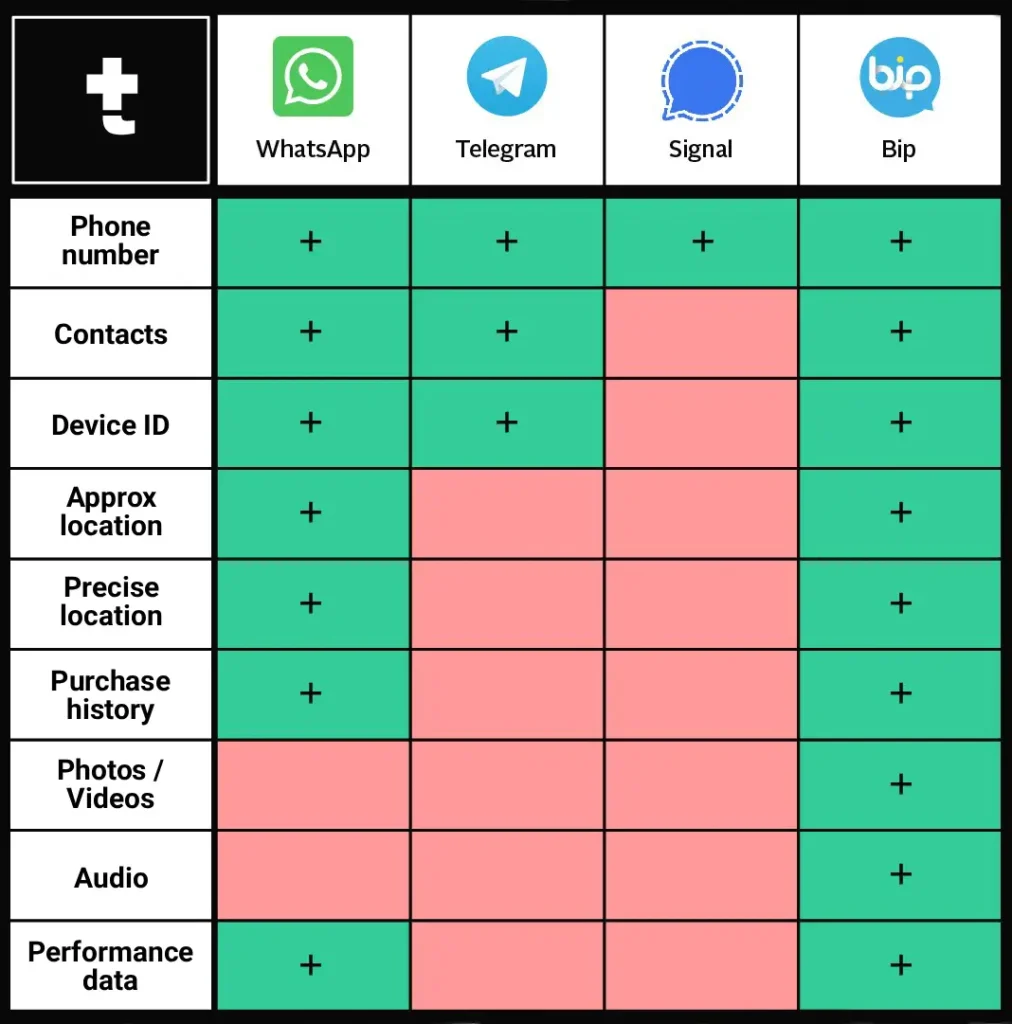
If the objection was to the specific changes in the updated Privacy Policy, why weren’t those changes actually read carefully? Because the stated reasons for the backlash don’t map directly onto what was actually updated. WhatsApp’s head, Will Cathcart, made a public statement emphasising that nothing had changed regarding the privacy of personal messages and that the update related specifically to business communications. That doesn’t make Facebook innocent or mean they collect no personal data at all. But it does mean the loudest objections weren’t quite aimed at the right target.
If the objection was to users being forced to accept the new terms or lose access from 8 February, that’s a different conversation entirely. Cathcart, responding to a user’s question on this, framed the deadline as a matter of transparency: they wanted everyone to be aware of the change. His position, essentially, was: these are my terms, take them or leave them. But he wasn’t saying “you’ll keep using the app while we harvest everything about you”. He was saying here are the terms, you choose.
Note: To be clear again: the point here isn’t to decide whether Facebook, WhatsApp or Cathcart are in the right or wrong when it comes to how the service operates overall. It’s to look at whether the reactions were actually connected to the thing people said they were reacting to. For what it’s worth, the ethically correct approach would be to let users decide individually which personal data can be used, much like cookie consent notices that let you opt in or out of specific categories.
The power of alternatives
Another factor behind the intensity of the reaction to WhatsApp, I think, is simply the existence of credible alternatives. Telegram, Signal, WeChat, BİP and others offer comparable functionality, and in several cases come out ahead on the very privacy concerns people were raising about WhatsApp.
Think about it: if there were no alternatives, would the backlash have been anywhere near as loud?
The fact that alternatives existed, were functional, and in many respects looked better on privacy made it much easier for people to push back. Because users felt they held the cards, that the decision was theirs to make. That sense of having a genuine choice is part of what gave the reaction its force.
The involvement of figures like Elon Musk, whose opinions carry real weight with large audiences, added further momentum. A single tweet from a respected voice increased trust in the alternatives considerably, and with it the intensity of the backlash against WhatsApp.
Habits… Oh, our habits…
As I mentioned at the start, the brain prefers the path of least resistance. It wants to conserve energy by sticking to what it knows, to established routines. It doesn’t particularly welcome change or novelty. When those habits exist at a societal level, change becomes even harder. It’s like someone who has used Windows their entire life trying to switch to macOS.
Companies like Facebook, Google and Apple understand this very well and build their products around it. The goal is to create habit-forming products, embed those habits at scale, and become indispensable.
WhatsApp is one of those habit-forming products. It’s used across every segment of society. For individuals and organisations alike, it has become the default communication channel. Giving that up isn’t going to be easy, regardless of how much the reaction suggests otherwise. Even with alternatives available, the brain will resist the switch. That said, the existence of alternatives does raise the realistic chance of change happening at a meaningful scale.
Facebook’s mistake, perhaps, was getting too comfortable with the habits it had created and assuming those habits made it untouchable.
Conclusion
Whether this global backlash ultimately does WhatsApp any lasting damage, whether anything changes in the short or long term, remains to be seen. But the mere possibility that a sustained reaction might give alternatives a real foothold is itself a meaningful development, at a time when consolidation and monopolisation are accelerating.
What would make these reactions count for more, and translate into lasting change, is knowing why you’re reacting. Understanding what you’re actually objecting to. Being, in short, a critical user rather than a reactive one.