You wake up to a beautiful morning. What’s the first thing you do? Wash your face, brush your teeth, make coffee, have breakfast? Is there anything else that comes to mind? Like checking your phone the moment you open your eyes, perhaps? Don’t deny it — I know many of you do. So do I.
If you’re willing to admit this is a bad habit, don’t worry: it’s not your fault. It’s the system‘s. And I don’t mean the shadowy external forces we tend to blame whenever something goes wrong — I mean our habit systems, which we’ve left unmanaged. Not unmanageable. Just “unmanaged”. In this post, I want to look at how habits form, the triggers that pull our attention away (or direct it), habit-forming products, their power to reshape us, and a few straightforward ways to push back.
The Habit Loop: How do habits form?
At any given moment throughout the day, we’re surrounded by things competing for our attention. A television programme, the smell of something burning in the kitchen, a notification sound from our phone. Given that the average smartphone user receives roughly 63.5 notifications per day, and that our phones are almost always within arm’s reach, it’s fair to say they’re one of the more significant sources of distraction in our lives. And the reason we react to these distractions almost involuntarily is the habits we’ve built up around them.
A habit, simply put, is a behaviour repeated regularly enough that it becomes automatic — a response triggered by a given situation without conscious thought. So how does a behaviour become a habit? How does this involuntary process actually work?
In Atomic Habits, James Clear describes how habits start, how they’re maintained, and how repetition builds them, through a four-stage loop:
Cue > Craving > Response > Reward
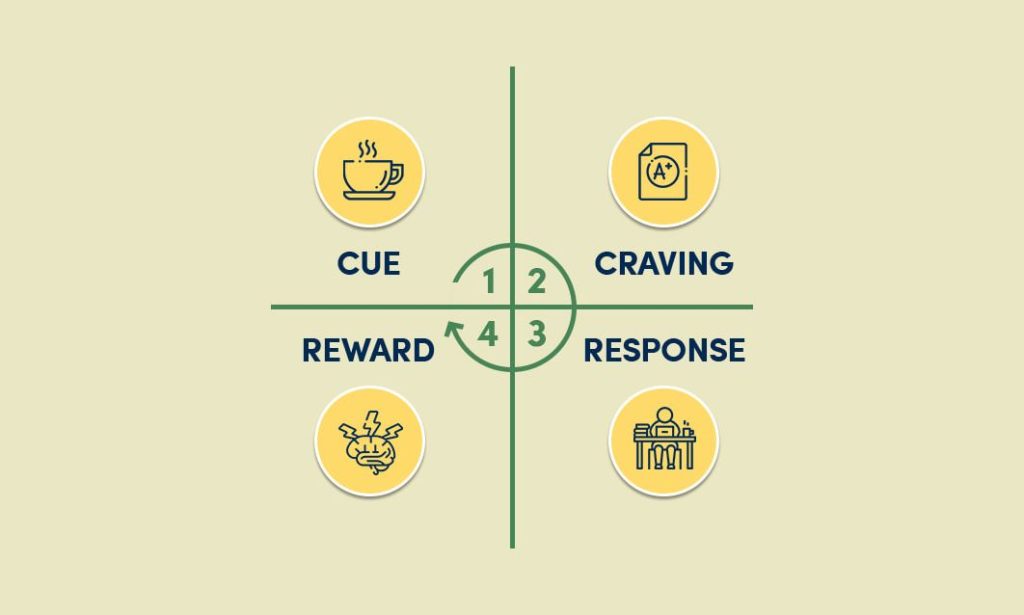
- Cue: A piece of information that triggers the brain to initiate a behaviour. The stage of noticing the reward.
- Craving: The motivational force needed to act. The stage of wanting the reward.
- Response: The action itself — a thought or a behaviour. The stage of obtaining the reward.
- Reward: The reward itself. Satisfying and instructive. This is where the brain learns whether the whole cycle is worth repeating.
All habits, good and bad, pass through these stages. A cue triggers a craving, a craving motivates a response, and a response delivers a reward. These four stages form a neurological feedback loop — cue > craving > response > reward > cue > craving > response > reward — that makes automatic habits possible. This is the habit loop.
In The Power of Habit, Charles Duhigg describes the habit formation process as a three-stage loop: Cue > Routine > Reward. In Hooked, Nir Eyal frames a similar cycle as: Trigger > Action > Variable Reward > Investment.
Let’s put this into practice with an example:
- Cue: You hear a notification sound from your phone — a new message.
- Craving: You want to know who it’s from and what it says.
- Response: You pick up your phone and read the message.
- Reward: The urge to know has been satisfied. The act of picking up your phone is now associated with that notification sound. The process becomes automatic.
The same framework can be used to build good habits or to break bad ones. Which means you can push back against the system and manage your habits intentionally. When habits go unmanaged, we hand ourselves over to whatever our brains are momentarily craving, and we become victims of our own involuntary patterns.
The fact that this process becomes automatic — pulling a person towards a reward without any conscious decision — can also make that person vulnerable. And as you might expect, that vulnerability is something companies looking to maximise their returns are very much aware of. And actively exploit.
Habit-forming products
What makes a product habit-forming is precisely the habit loop described above — the steps within it, and the actions those steps produce. It’s also worth noting that many of these products weren’t designed and then discovered to be habit-forming by accident. They were designed to be habit-forming from the start.
Deliberately building a habit is difficult. Breaking an existing one is harder. Let’s look at this through the framework Nir Eyal uses in Hooked — Trigger > Action > Variable Reward > Investment — which approaches habits more from a marketing and product perspective. The trigger, action, and reward stages are more relevant to the process of forming a habit, so let’s skip those and focus on the one element in Eyal’s model that doesn’t appear in Clear’s loop: Investment.
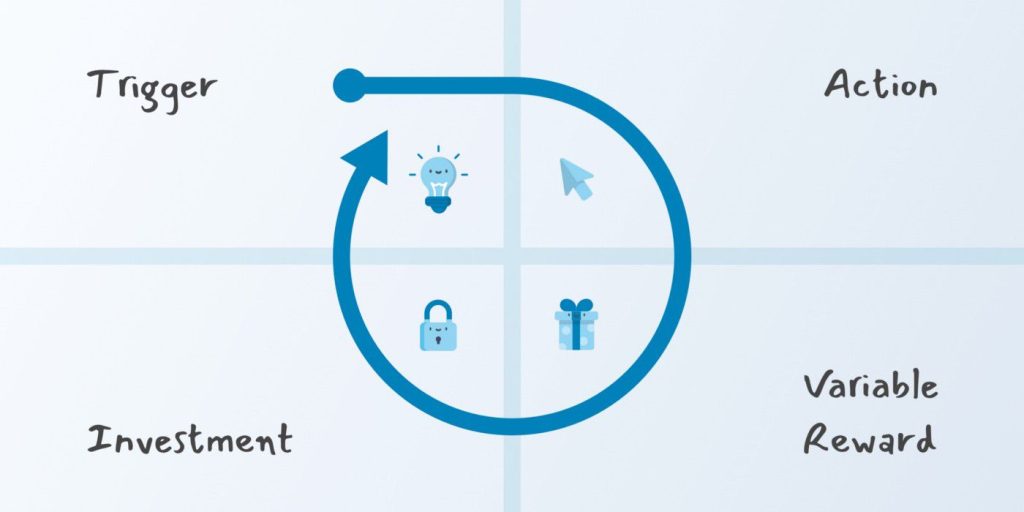
Perhaps the most powerful reason we can’t let go of a habit is the investment we’ve made in it. If that habit involves a habit-forming product, the investment can take many forms: the time you’ve spent on a platform, the money you’ve put in, the photos you’ve uploaded, the followers you’ve accumulated.
- If your Instagram following or engagement is significantly larger than on Twitter, you’re less likely to leave Instagram than Twitter.
- If you’ve been playing League of Legends for ten years, you’re less likely to quit it than Dota 2, even if you think Dota 2 is the better game — despite only having started it two months ago.
- If your photo library is in Google Photos rather than iCloud, you’ll need a compelling reason to switch. You’ve made a significant investment in Google Photos, and moving is genuinely costly in terms of time and effort.
In short, the greater the investment, the lower the likelihood of walking away.
That’s just the investment dimension, of course. There’s also convenience, accessibility, speed, emotional attachment, tribal psychology, and more. The uncomfortable truth is that giving up a habit — especially a habit-forming product — is difficult and costly.
You may remember that roughly two years ago, WhatsApp’s decision to update its Privacy Policy — and to inform users that those who didn’t accept the new terms would lose access to the app — sparked significant backlash in Turkey and elsewhere. Even Elon Musk weighed in and told people to “use Signal“. In the wake of that reaction, usage of more privacy-focused alternatives like Signal and Telegram spiked, and headlines appeared suggesting the end was near for WhatsApp. In my January 2021 post, “The WhatsApp Dilemma and Our Digital Habits“, I wrote that this particular break-up wasn’t going to be as straightforward as people hoped. Because WhatsApp is, by its very nature, a habit-forming product. And habits aren’t something you walk away from over a couple of simple grievances, unfortunately.
Impossible? Of course not.
What can you do? Is digital minimalism actually possible?
When the habit loop becomes fully automatic, it starts to affect daily life in ways that are hard to ignore. Some habits look small on the surface, but add up the cumulative effect over time and the scale of the impact becomes clear.
Think back to the notification example from earlier. “Picking up your phone every time a notification sounds” might seem harmless enough, but it’s a bad habit. Because you never just look at the notification. You get pulled into the products the attention industry has carefully designed to capture exactly that moment of weakness.
Everyone knows how irritating it is when someone at a dinner or a gathering picks up their phone every time it makes a sound. Most of those people keep doing it anyway. The person whose phone just notified them might hold off for a moment, but their attention is already gone, and they’ll pick it up eventually. Because it’s become an involuntary habit, and they need to complete the loop to get the reward.
Go out and ask someone at random: “How much time do you spend on social media in a day?” Whatever figure they give you will almost certainly be lower than the actual number. That’s because some habits are invisible to the people who have them. Try it yourself: estimate how long you’ve been on Instagram today, then go to your profile settings and check your actual usage. The gap will probably surprise you. Because we genuinely don’t see it.
According to James Clear, for a behaviour to change it needs to be made obvious, attractive, easy, and satisfying. Even a small, atomic change at any of these points can have a significant effect. If you want to break an unwanted habit, you do the opposite of all four.

Let’s stay with the phone example.
After reading Cal Newport’s Digital Minimalism, I realised I’d built up exactly the habit of reaching for my phone at every notification sound. But I also realised that the work I do is primarily done on a computer, not a phone. So there was no real reason I needed to be checking messages, social media, or emails on my phone in real time. I turned off all phone notifications except calls — no sound, no vibration — and decided to try living like that for a while.
That was roughly two years ago. The notifications are still off. I haven’t missed anything professionally. Has anything been gained? Quite a lot, as it happens. Removing a major source of interruption meant my ability to focus improved noticeably — on work, and in general. I also noticed a significant reduction in the chain reactions that notifications used to set off. You pick up your phone for one notification, and somehow you’ve also had a quick look at Instagram, popped briefly into TikTok, and scrolled through your photos. None of these visits were planned, and none of them were quick. The “just a second” moments stack up, and you don’t notice until a significant amount of time has gone.
It didn’t take long to realise I could take this further. I removed every app from my phone that I rarely used and didn’t feel I was losing anything by not having. Re-downloading something when you actually need it isn’t difficult. But now there’s a small additional cost to accessing those apps, which means I need a genuine reason to reinstall them. Fewer apps on the phone means fewer reasons to pick it up out of habit.
You can try something similar, combining the approaches of Clear and Newport. There’s nothing to lose and potentially quite a lot to gain. Working from the same phone example, here’s how the logic applies:
- Make it invisible: Keep your phone out of immediate reach wherever possible. Put it somewhere you won’t easily see or hear it, so the cue doesn’t fire every time.
- Make it unattractive: How can you make the habit of reaching for your phone feel less appealing? This one is personal — the answer will depend on your own situation.
- Make it difficult: In other words, add friction. A complicated screen lock, removing apps so you have to reinstall them from scratch each time you want to use them.
- Make it unsatisfying: Like point two, this requires some self-knowledge. If you can remove the sense of reward or gratification from the behaviour, you break the habit loop.
The first three laws above — making a behaviour obvious, attractive, and easy — increase the likelihood of it happening. The fourth, making it satisfying, increases the likelihood of it being repeated. Repeated behaviour is how a habit forms. Reversing all four is how you dismantle one.
Note: The goal in the phone example isn’t to never look at your phone. It’s to stop notifications from hijacking your attention on their schedule rather than yours, and to make the frequency of checking something you control.
These same principles can be applied across many areas of life. If we want to build a good habit or break a bad one, we have to manage the habit loop. That’s the system I mentioned at the start.
Conclusion
If you’ve read the book or seen the film, you’ll remember that the members of the Dead Poets Society opened every meeting with Henry David Thoreau’s quote on “purposeful living”. That same Thoreau, writing Walden while living as minimally as he possibly could, developed an economic theory that put “time” in place of “cost” — a direct challenge to standard economic thinking. In his framework, “the cost of a thing is the amount of what I will call life which is required to be exchanged for it, immediately or in the long run.” Conventional economics would say: if a farmer can earn one dollar a year from one acre of land and has sixty acres, he should work all sixty and earn sixty dollars. Thoreau thought this calculation was desperately incomplete, because it entirely ignores the cost in time and life of earning the extra fifty-nine dollars.
Thoreau, who valued minimal living and time above accumulation, and who understood how hard it is to let go of excess, has quite a lot to tell us. Time is real. Time is limited. Time matters...
Here’s to recognising what actually matters within our finite time on earth, letting go of the habits and the clutter that feed our primitive brains’ appetite for instant gratification and quietly “steal our attention” — and to ignoring the notifications that don’t deserve it.
Sources and further reading:
- Atomic Habits: An Easy & Proven Way to Build Good Habits & Break Bad Ones – James Clear (Book)
- Hooked: How to Build Habit-Forming Products – Nir Eyal (Book)
- The Power of Habit: Why We Do What We Do in Life and Business – Charles Duhigg (Book)
- Digital Minimalism: Choosing a Focused Life in a Noisy World – Cal Newport (Book)
- Walden – Henry David Thoreau (Book)
- Dead Poets Society – N. H. Kleinbaum (Book)
- An in-situ study of mobile phone notifications – Martin Pielot, Karen Church, Rodrigo de Oliveira (Article)