
Human behaviour, which many scientists are working intensively to understand, is considered an enigma — precisely because it is irrational and refuses to conform to classical theories.
Mathematically unaccountable, incompatible with probability theory, riddled with uncertainty, inconsistent, disorderly, illogical — and utterly fascinating enigma…
The research conducted on human behaviour to date has given us important data suggesting that some of it is predictable. Scientists like Nobel laureate Daniel Kahneman and Amos Tversky have done groundbreaking work in this field, opening up entirely new directions in the social sciences. It’s fair to say that when behavioural science and behavioural economics come up, Kahneman is the first name anyone points to.
Working together, Kahneman and Tversky produced a body of psychological research in behavioural science that generated some remarkable findings about human judgement and decision-making under conditions of uncertainty. Let’s look at two of the most significant.
1. Dual-Process Theory: The mind operates through two distinct systems, which Kahneman calls System 1 and System 2. System 1 represents fast, intuitive, effortless choices; System 2 represents deliberate, effortful ones.
System 1 is our unconscious, emotional, automatic system — operating faster than we can be aware of. It’s at work when we’re driving, tying our shoelaces, stepping over a puddle, walking a familiar route on autopilot, or having an easy conversation with someone we know well.
System 2 is our slow, rational system — the one that consumes mental energy and works through complex problems. It kicks in when we’re scanning a crowd for a friend, trying to reverse-park into a tight space, doing long division, or concentrating on something important.
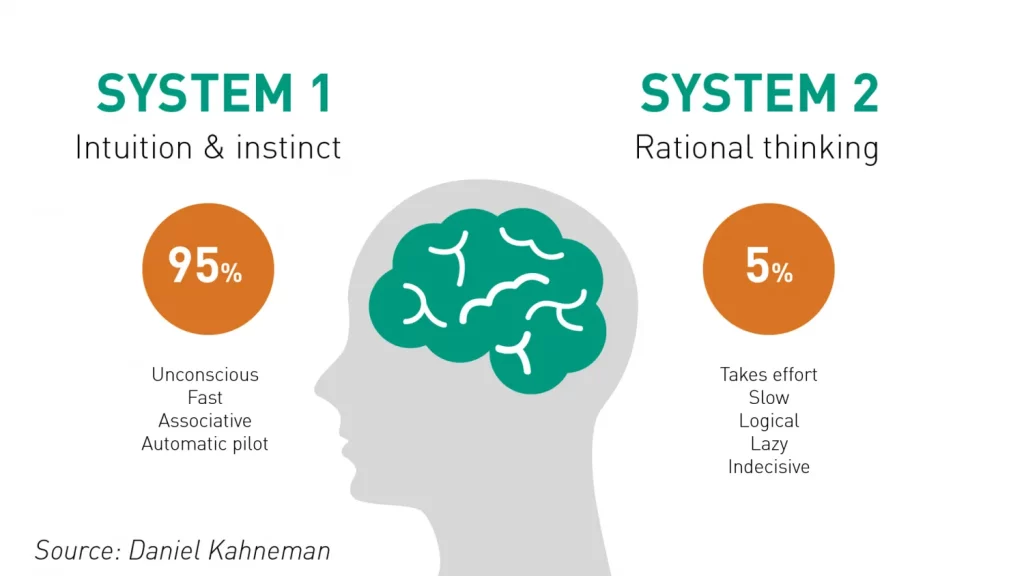
A useful illustration of the difference is the Stroop effect — a well-known phenomenon in psychology.
The Stroop effect demonstrates cognitive interference: when there’s a mismatch between stimuli, reaction time on a task slows down.
In the Stroop test, participants are asked to say the colour of the ink each word is printed in — out loud. The brain gets stuck between the word itself and the colour of the ink, responses slow down, and errors are common (people tend to read the word rather than name the colour). This is caused by the conflict between the two stimuli. You can try it yourself.
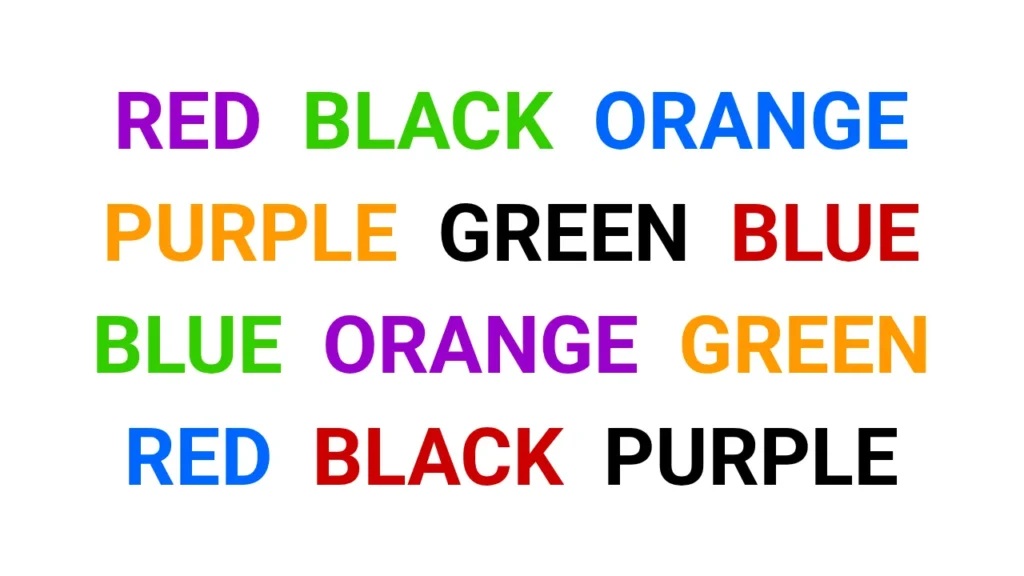
Kahneman explains this through the System 1 / System 2 distinction. System 2 is working to identify and say the ink colour, but the faster, automatic System 1 jumps in and reads the word.
For Kahneman, this simple example shows that System 1, despite being productive and practical, can frequently interfere with deeper mental processes. It affects our day-to-day decision-making in ways we don’t expect — and often can’t prevent, or even notice.
Note: This is usually the point where questions about free will tend to surface. If you’re interested, I’ve written about this in an earlier post: “Is Free Will an Illusion in the Digital World?“
2. Prospect Theory and Loss Aversion: Our reference points shape our economic decisions, and losses consistently feel larger than equivalent gains.
A simple coin flip example illustrates this:
Say we’re playing a coin-toss game with money on the line. If you win, I give you £100. If I win, you give me £50. Would you play?
Most people would say “no”. Nobody wants to risk losing £50 for nothing, even with £100 on the other side.
Standard economic theories like expected value theory would say you should play. The probability of winning and losing are equal (50/50), and your potential gain is twice your potential loss.
The problem is that classical economic theory assumes humans are rational actors. According to Kahneman, they aren’t.
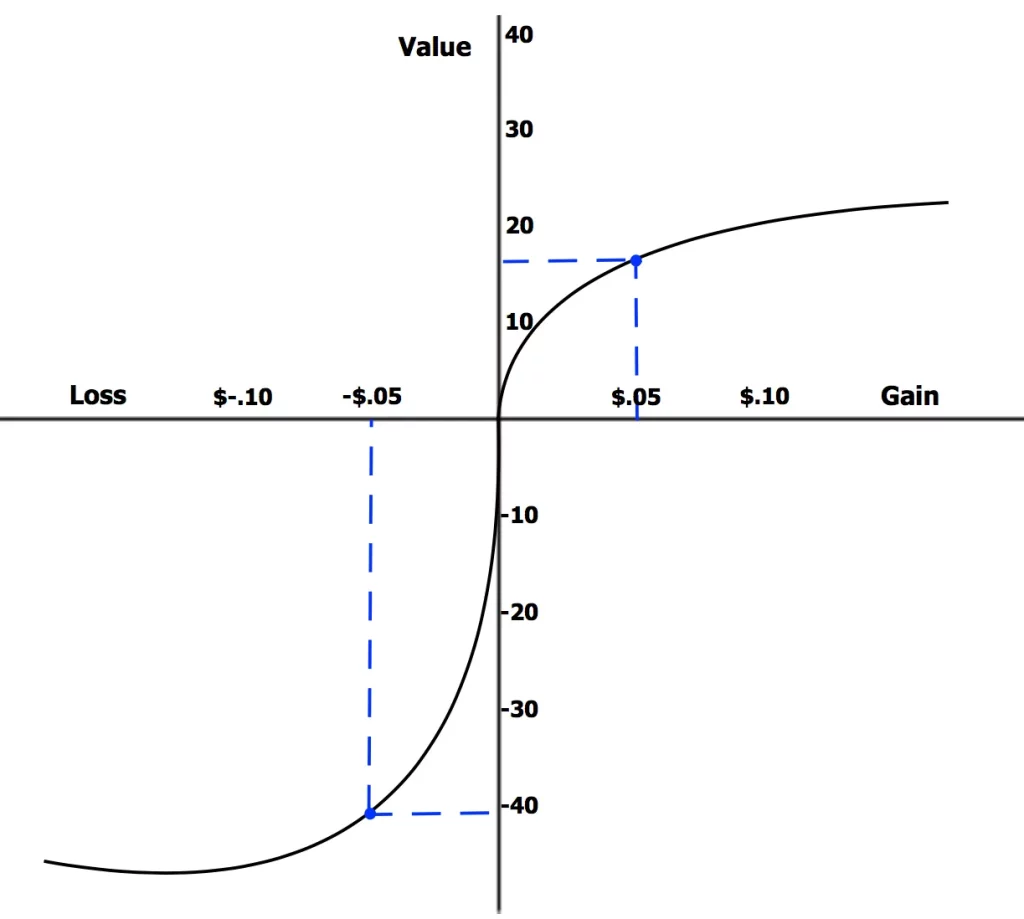
Kahneman and Tversky’s prospect theory and the concept of loss aversion hold that the negative impact of losing something feels significantly greater than the positive impact of gaining the same thing. This is why most people avoid the coin-toss game above.
Prospect theory also tells us that the reference point you’re starting from shapes the path you take when making a decision. Someone with £50 in their bank account is less likely to play the coin-toss game than someone with £100,000. This sounds intuitive, but standard economic theories that treat humans as rational actors don’t account for it.
We are caught between bold forecasts and timid decisions. — Daniel Kahneman
Human Irrationality and Uncertainty
In mathematical terms, anything that doesn’t fully conform to the rules of classical probability theory is considered irrational. Human behaviour is considered irrational for exactly this reason, by Kahneman and many other cognitive scientists.
Let’s illustrate this irrationality with another example.
A study by Amos Tversky and Eldar Shafir found that most students who pass their end-of-term exam want to take a holiday straight afterwards. Students who fail their exam also, it turns out, want to take a holiday straight afterwards.
According to classical probability theory, students should be likely to take a holiday regardless of their result. In other words, the exam outcome shouldn’t affect whether they go.
But in the experiment, students who didn’t yet know their result were observed to be reluctant to book the holiday before finding out.
We can all intuitively grasp why: a student who goes on holiday while anxiously waiting for results will probably spend the whole time thinking about it and won’t fully enjoy themselves. But classical probability theory can’t explain this. So the students’ behaviour is classified as irrational.
This kind of irrationality — non-conformity with classical probability theory — can be observed in another domain entirely: the quantum world. Which raises an interesting question: can quantum mechanics explain the mystery of human behaviour?
The Chaotic World of Quantum
Events at the quantum level are, like human behaviour, irregular. In classical theories, the order in which questions are asked doesn’t affect the answers. In quantum physics, answers can vary depending on the sequence in which questions are posed — there is order dependence.
The spin of electrons is a good example. If you measure the spin of an electron first vertically and then horizontally, the result will differ from what you’d get if you reversed the order.
Note: In quantum systems, the act of measurement itself affects the outcome. (See: Observer Effect, Double-Slit Experiment.)
Human behaviour also shows order dependence. We know this from a 2002 study examining whether the sequence in which questions are asked changes the answers people give.
Participants were asked whether they thought former US President Bill Clinton was honest. They were then asked the same question about Vice President Al Gore.
Asked in this order, the proportions saying each was honest were 50% and 60% respectively. When the order was reversed — Gore first, then Clinton — the figures shifted to 68% and 60%.
This inconsistency in human behaviour stems from its violation of classical probability theory. But it appears to fit neatly with the way probability operates in quantum mechanics.
To make this clearer, let’s combine two of the examples above — the coin toss and the exam result — and see where they lead.

Imagine you’re playing the coin-toss game again. Heads, you win £200. Tails, you lose £100. You’re also given the option to flip a second time, but the choice of whether to do so is yours. Would you flip once or twice?
A 1992 study published in Cognitive Psychology examined exactly this. The finding: regardless of the outcome of the first flip, most participants chose to flip a second time — either to build on a win or to recover from a loss.
Now: if you didn’t know the result of the first flip, would you still play the second?
This is where the real inconsistency emerges. In the experiment, most participants who didn’t know the outcome of the first flip chose not to play the second. In other words, those who knew the result — whether they’d won or lost — were willing to play again; those who didn’t know the result were not. Put differently: a certain loss feels preferable to an uncertain gain.
The quantum world is similarly full of uncertainty. Just as an electron can be at point A or point B at a given moment, quantum mechanics holds that a first coin flip can be simultaneously both a win and a loss — much like Schrödinger’s famous thought experiment, in which the cat is simultaneously both alive and dead.
When a person is caught in this uncertain state — known as superposition — their ultimate choice is unknown and unpredictable. Quantum mechanics also acknowledges that a person’s beliefs about what a particular decision will lead to (whether it will be good or bad) tend to reflect what their final choice will be. In this way, a person’s beliefs become entangled with their eventual actions.
Subatomic particles can also become entangled, influencing each other’s behaviour regardless of the distance between them. A measurement of a particle in London can change the behaviour of its entangled counterpart in Tokyo. Research suggests that a similar analogy can be drawn in psychology, between beliefs and behaviour.
Quantum Cognition and AQI
The structural similarities between the quantum world and human behaviour in terms of inconsistency have drawn cognitive scientist Jerome Busemeyer and a number of other researchers into this area. Many who have begun working in this field argue that quantum mechanics can explain human behaviour more consistently than classical theories.
This intriguing hypothesis has given rise to a new field of research called quantum cognition — an intersection of quantum physics and human psychology.
While studies conducted in this field so far have produced findings that support the hypothesis, scientists are clear that it’s far too early to draw firm conclusions. Jerome Busemeyer, Xiaochu Zhang, Emmanuel Haven, and Andrei Khrennikov are among the prominent figures who continue to work in quantum cognition — and they remain convinced that quantum modelling can explain human behaviour.
There’s also the question of how these ideas might eventually reach end users through accessible technological tools. With artificial intelligence at its current peak, AI systems are becoming increasingly sophisticated in modelling human behaviour.

Whether current AI systems are rational or irrational is still debated, but most are known to be built on classical theories, learning and generating behaviour through methods such as pattern recognition, evaluation, contextualisation, and imitation. Could AI systems ever exhibit genuinely human-like behaviour, of the kind we see in science fiction? The answer to that question may lie in the capacity to explain human behaviour at the quantum level.
British physicist and mathematician Dorje C. Brody, in a paper published in September 2023, gave this concept a name: Artificial Quantum Intelligence (AQI) — not to be confused with Quantum Artificial Intelligence (QAI).
Brody argues that if human behaviour can be explained at the quantum level, AI systems designed to replicate it more accurately would need to follow quantum rules rather than classical ones. Whether that would actually be a good idea remains, for now, uncertain.
Conclusion
The work done by Daniel Kahneman and many other scientists in behavioural science and behavioural economics has generated new ideas and alternative approaches across a wide range of fields — from economics and politics to education, marketing, community management, and the resolution of social and environmental problems.
Knowing how humans are likely to behave is also, inevitably, a form of power over them. The research done so far sheds some light on where and how this knowledge has been — and can be — applied. We can already see both good and troubling examples of this across marketing, politics, and beyond.
When it comes to understanding irrational human behaviour through the lens of quantum theory, we are still very much at the beginning. Perhaps, in time, this approach will bring us closer to understanding the reasons behind inconsistent behaviour — its flaws, its disorder, its strange internal logic. Who knows…
Sources & further reading:
- Thinking, Fast and Slow – Daniel Kahneman (Book)
- Irresistible: The Rise of Addictive Technology and the Business of Keeping Us Hooked – Adam Alter (Book)
- Maps of Bounded Rationality: Psychology for Behavioral Economics – Daniel Kahneman
- The Disjunction Effect in Choice under Uncertainty – Amos Tversky, Eldar Shafir
- Advances in prospect theory: Cumulative representation of uncertainty – Daniel Kahneman
- Measuring New Types of Question-Order Effects: Additive and Subtractive – David W. Moore
- Thinking through uncertainty: Nonconsequential reasoning and choice – Amos Tversky, Eldar Shafir
- Quantum formalism for the dynamics of cognitive psychology – Dorje C. Brody
- Could quantum physics be the key that unlocks the secrets of human behaviour? – Dorje C. Brody / The Conversation
- What is quantum cognition? Physics theory could predict human behavior – Nicoletta Lanese / Live Science
- Daniel Kahneman: The Father of Behavioral Science – The Decision Lab