
We tend to think of the internet as one of the most significant inventions of the information age we currently inhabit. Given that many researchers working in the field share this view, it’s a reasonable position to hold.
When it comes to communication tools specifically, we often say the internet occupies an “entirely” different place, that it brought something genuinely new to communication. That’s “partially” true.
The internet encompasses all the communication tools that came before it: speech, manuscript, print, and audiovisual media. Rather than calling it a “brand new communication tool”, it’s more accurate to describe it as a medium that contains all previous forms of communication within itself, and precisely because of that quality, one that spread rapidly and transformed communicative behaviour. Within the communication networks the internet provides, speech, writing, printed materials, radio and television all coexist.
While there are many features that distinguish the internet from other communication tools, the cultural transformations we’ve witnessed as a result of its influence will give us a great many clues about the evolution of communication itself.
In my blog post from June 2020, “The Evolution of Communication and the Impact of Social Media“, I tried to examine the transformation of communication through the lens of social media. In doing so, I drew on Marshall McLuhan, one of the great figures in the world of communication, known for his famous phrase “The medium is the message”. In this post, I’d like to draw on another Marshall: American historian and writer Marshall Tillbrook Poe, and use his work to look at the cultural changes brought about by communication tools, and ultimately at the internet’s role in those changes.
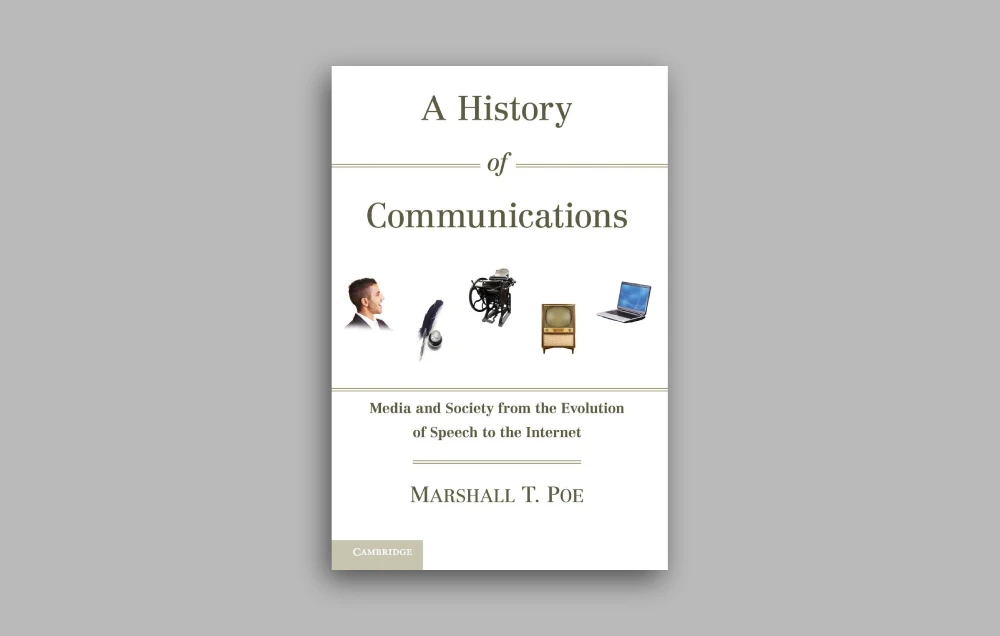
In his book “A History of Communications: Media and Society from the Evolution of Speech to the Internet”, Poe examines communication, communication tools, and the social and cultural changes they have caused, under the framework of general media theory. He also uses push and pull sub-theories, inspired by Canadian communications theorist Harold Adams Innis, to formulate communication tools.
Rather than focusing on the technical properties Poe uses to classify communication tools — accessibility, speed, fidelity, durability, volume, privacy, searchability, reach and so on — let’s dig into the cultural changes that occurred alongside the historical development of communication tools and media, working through the periods Poe identifies.
Homo Loquens: The Speaking Human
There is one important difference that sets speech apart from all other communication tools: we didn’t invent it. Having been the only known means of communication for over 150,000 years, its monopoly must have created a certain speaking culture within societies. But finding direct evidence of this today is extremely difficult. While some researchers have worked on the subject, their work doesn’t describe the effects of speech on ways of living. So we’ll have to proceed indirectly, as if there were no direct evidence at all.
But why do we speak? Why did we alone, among all animals, evolve the capacity for speech? The answer is actually straightforward: we began to speak because, evolutionarily, it was advantageous. The first humans who could speak had more children than those who couldn’t, and the genetic capacity for speech spread gradually through the entire species until everyone could speak. Of course, this doesn’t explain why speech was evolutionarily advantageous. Evolutionary theorists who recognised this question have developed various theories in response.
In his book Why We Talk: The Evolutionary Origins of Language, French researcher Jean-Louis Dessalles explains this through the lens of how archaic humans chose their allies. According to this view, chimpanzees living in small groups, for instance, select allies based on strength, size and loyalty. When group sizes are compared, it becomes clear that archaic humans needed a different ally-selection strategy. Dessalles argues that the key factor here was the ability to convey “relevance”.
The concept of “relevance” Dessalles describes refers to speech that is useful to listeners, and that thereby presents the speaker as a potential ally. In short: relevance secures the ally, the ally secures dominance within the group, dominance increases reproductive chances, and more reproduction spreads the genes that produce relevance. This makes speech, and “relevance,” an important competitive matter.

This explanation for why archaic humans felt the need to speak also shows us how small the groups within which speech-based communication took place actually were, given its constraints of speed and distance. In other words, we can say that communication through speech necessarily happened in small groups.
Describing the effects of communication in the age of speech on the people living then isn’t really possible through evidence alone, since the first hunter-gatherers left very little behind in physical terms. So, as Marshall T. Poe does, we have to use inference and look at contemporary equivalents of hunter-gatherer groups in terms of their ways of life. To see how speech-age communication affected human life and social existence, we can look at small-scale groups like the modern family, circle of friends, or workplace. Like the early hunter-gatherer groups, these are small, and the work within them is mostly carried out through face-to-face, verbal communication.
Groups like the family, friends, or workplace operate within a context where members are relatively equal, because they have no other way to function. There are hierarchies, of course: between parent and child, or employer and employee. But regardless of hierarchy, the freedom of every member to speak practically limits power. Even a manager with formal authority needs to get on well with people to be an effective leader. Everyone in the group must be respected and given the right to speak and be heard.
Something similar can be said of early hunter-gatherer groups. Men had more authority than women, and the strong had more than the weak. But all adult members of the group were permitted to speak and listen, because no one could successfully prevent them from doing so. The idea of suppressing or punishing a group member who couldn’t be stopped from speaking was a risky proposition, since it was unclear who would prevail. Permanently silencing someone by killing them could have serious consequences: murder was strongly discouraged among early hunter-gatherers. After all, everyone was, at least distantly, related, and no one was entirely expendable.
This unstoppable freedom of speech among group members, and its distribution across those members, shaped the formation of certain values. In terms of communication, people were equal, and it was believed they should be at least roughly equal. Equal access to speaking and listening reinforced the ideas that property, especially valuable goods and food, should be shared, and that everyone should look out for one another. While this applies more directly to early hunter-gatherers, something similar can be said of the small groups we see today.
In short, we can say that speech, which was so important within small groups like families, friends, and workplaces, contributed to the development of a culture of “sharing”.
Homo Scriptor: The Writing Human
When it comes to writing culture, the name that comes to mind first, with his sharp criticisms, is undoubtedly Plato. Plato’s view of this communication tool was negative. He found in writing the same flaw he’d found in rhetoric. According to him, both rhetoric and writing prevented the kind of dialogue that was the only path to truth. He believed writing dulled memory.
“This invention will produce forgetfulness in the minds of those who learn to use it, because they will not practice their memory” — Plato, Phaedrus, 275A
Plato also objected to writing because it could fall into the wrong hands. In dialogue, philosophers could defend themselves against unjust attacks. But once something was committed to writing, that became impossible. In Plato’s view, the silent text “cannot defend or help itself.” He even declined to make literacy a requirement in the Republic.
It might sound somewhat contradictory that Plato, who was so opposed to writing, committed all of these views to writing. But it’s worth remembering that Plato, who was against all forms of monologue, wrote exclusively in dialogue format.
For Plato, writing was not a path to truth but a tool for manipulation, and he wasn’t wrong about that. As we discussed in the Homo Loquens section, those in power couldn’t stop people from speaking, but they could control writing, and therefore meaning. All of this not only brought an end to hunter-gatherer groups but led to the emergence of the hierarchical societies we know well.
We mentioned earlier that very little evidence was left behind from the age of speech. That’s why we had to draw on inference, as Marshall T. Poe does, and look at small groups like families, friends, and workplaces to understand how communication in that era affected human life. With manuscript culture, however, more was left behind, which allows us to proceed on firmer ground.
Around 300,000 years ago, our ancestors appear to have been collecting pieces of red ochre, which they are thought to have used for symbolic purposes, though precisely how remains unclear. Around the same time, a minimalist drawing was made on an ox rib. And we know of pierced shells, dating back roughly 100,000 years, that appear to have been used as jewellery. Between 40,000 and 30,000 years ago, evidence of symbolic production becomes abundant: beads, drawings, carvings, paintings, and burials. While these examples show that archaic and early humans used objects as symbols, they didn’t particularly need to do so yet.
The communal living spaces that emerged after the shift to settled life led to the creation of public buildings providing various social services. This in turn created the need for those producing those services, rulers and priests, to collect taxes from those receiving them. It was precisely at this point that a reason to create symbols systematically was found for the first time: record-keeping. Rulers and priests needed to track who had contributed what to their treasury, and how much was in it.
Since numbers hadn’t yet been invented, calculations were initially made by assigning numerical meaning to physical objects, which were later turned into tokens of various shapes (cones, spheres, discs and so on). This token system was used for a remarkably long time: for approximately 5,000 years, until writing was developed.

The use of tokens, which first appeared in agricultural village conditions, proved insufficient around 4,000 BC in Mesopotamia, when cities of unprecedented scale like “Uruk” (the ancient Sumerian city located roughly 300 kilometres south of present-day Baghdad) came onto the scene. These advanced cities had also become large-scale trading centres. This led to the invention of the first writing system, pictographic writing, as a way of processing information more easily than tokens allowed.
As drawings of tokens on clay tablets replaced the tokens themselves, and the system was developed further, cuneiform writing emerged (around 3,100 BC). These writing techniques, initially used for record-keeping and information processing, gave rise to the idea that they could also represent words, and logographic writing systems were developed. For the first time in history, it became possible to record exactly what someone had said, and to present things never said as if they had been.
The difficulty with these writing techniques, where symbols represented words, was that anyone wanting to decipher them needed a lookup table, a kind of dictionary. Keeping track of all the symbols for every word was extremely difficult. The solution was to create a system of symbols representing not words but individual sounds: the phonetic alphabet. With this, the entire set of symbols, now smaller in number, could be memorised, and by combining these simple symbols, any word that could be spoken could easily be written.
The modern alphabetic writing system appears to have first emerged in Egypt around 2,000 BC. Interestingly, even though some scribes of the time recognised the potential of this economical writing system, the phonetic alphabet went unused and unspread for roughly 1,000 years, simply because there was no felt need for it. Eventually the Phoenicians adopted the alphabet, spread it across the Mediterranean basin, and it was adapted to local languages throughout the region. One of those languages, as we know from Plato’s writings, was Greek.
It’s worth noting that attributing the birth of writing solely to the Middle East would not be entirely accurate. The development of writing was the result of a process that unfolded more or less simultaneously in many parts of the world: agricultural activity begins, cooperative ways of living emerge (villages, cities, states, temples), rulers and priests who govern these spaces arrive, a need for record-keeping and information processing arises, and various writing systems are developed. This chain of inseparable stages ultimately gives rise to what is called “Manuscript Culture”.
When we examine the effects of Manuscript Culture on society, we can say with confidence that the results will look very different from those of Speech Culture. Speaking is part of human nature, so it is not a costly form of communication. Reading and writing, however, are learned and require effort. They are costly.
There was no mass literacy during the period of Manuscript Culture. There are two fundamental reasons for this. First, unlike speaking, reading and writing are learned and require effort, so most people simply didn’t learn them because they had no need to and didn’t want to bear the cost of doing so. Second, rulers, priests, and scribes who were paid for their work wanted to keep this communication tool as their monopoly. As we noted when we returned to Plato: writing had the quality of being a “tool for manipulation”.
Manuscript Culture also ushered in a period that fundamentally changed beliefs. Sacred texts were composed of words that God had spoken to chosen people, so if you could read, you could understand God. Since ordinary people couldn’t read, this was exploited repeatedly by those who could, and the literate elite were able to position themselves between God and the people. This gave them considerable status within society.
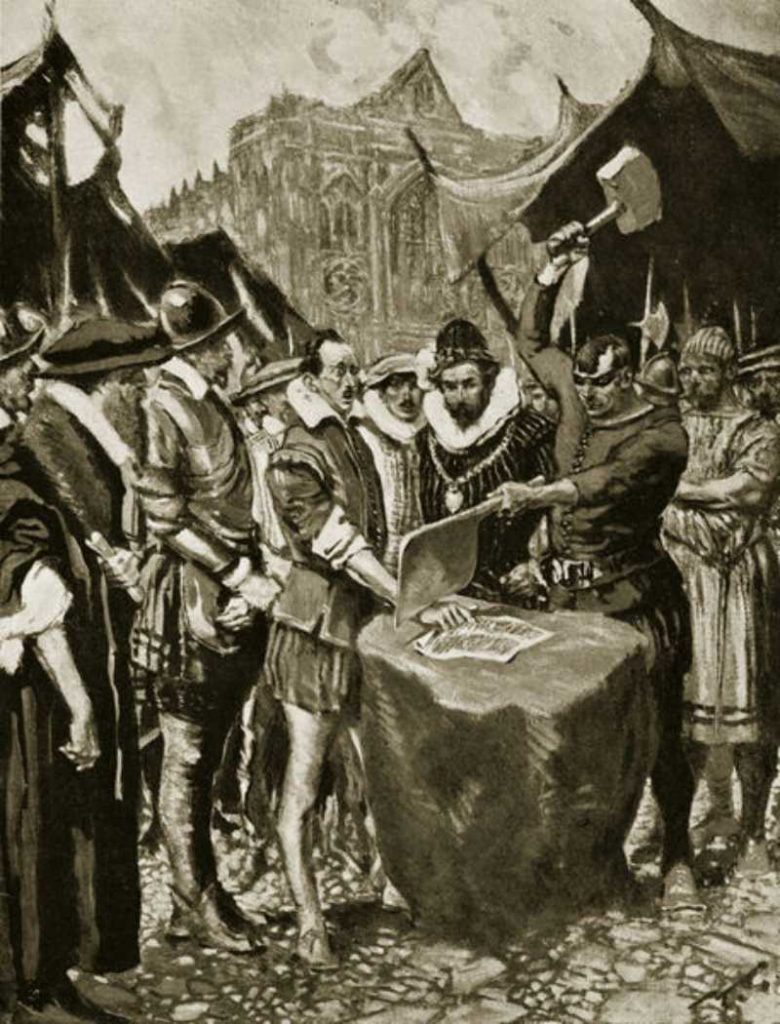
We mentioned how difficult it is to stop people from speaking. Writing, being more of a physical object, was considered something that could be easily suppressed by those in power. And it was. In the 16th century, for instance, Queen Elizabeth I of England ordered the right hand of a writer named “John Stubbs” to be cut off for writing things she disapproved of. Compared to speech, writing was therefore a communication tool over which power could be exercised.
In short, Manuscript Culture, which dominated much of the world for over 4,000 years, gave rise to a class division and hierarchical order, partly because reading and writing were kept as the monopoly of the elite and used for manipulation. Unlike Speech Culture’s ethos of equality and sharing, Manuscript Culture produced a “us and them” division.
Homo Lector: The Reading Human
Plato argued that dialogue was the only thing needed to reach truth, and that both rhetoric and writing should be excluded from the equation precisely because they were monologues. He also believed that truth could only be reached by those with sufficient capacity for it. In his view, those who would govern the state needed to have and be trained in that capacity. Explaining truth to those with insufficient mental ability and education was pointless, because it would only confuse them.
Because the truth needed to be kept from the inadequate masses, Plato considered censorship and propaganda legitimate tools of the state. While this was unusual thinking in Plato’s time, it was perfectly normal within Manuscript Culture, because power held writing, and writing held power. But with the development of printing, the rulers who had monopolised writing for thousands of years began to lose control of knowledge, and therefore of truth. Things turned out differently from what Plato had foreseen.
The emergence of the printing press (in the mid-15th century) is most commonly associated with the German inventor Johannes Gutenberg. But it’s more accurate to think of the printing press as a process rather than a single invention. Various printing techniques, types of ink, and forms of paper all existed before the press we associate with Gutenberg.
Paper, for instance, was invented by the Chinese in the 1st century, spreading to Korea, Japan and Central Asia in subsequent centuries. It reached the Islamic world in the 8th century and Europe in the 12th. In other words, paper mills were operating across Europe well before Gutenberg invented the press, and paper had become the preferred material.
The same is true of printing itself: seals and stamps used by ancient civilisations, stone and woodblock printing that first appeared in China before spreading westward, mechanical presses and types of ink used in Manuscript Culture. All of these show that the technologies required for the printing press existed and were in use long before its invention, in some cases centuries earlier.
So how did the printing press emerge at a time when writing was the modern form of communication and that writing was held in the hands of the powerful? What were the turning points that led to its appearance and to rulers losing control of information?
The technologies needed to print large quantities of text were on the market centuries before Gutenberg, and in at least one instance had been used for exactly that purpose. As we noted, the Chinese were printing with stone and wooden blocks as far back as 1,000 BC or earlier. But until the 8th century, these techniques hadn’t been redesigned for mass production, because China’s pool of scribes was large enough to copy everything needed. In the early 8th century, however, Empress Wu ordered the mass production and distribution of Buddhist texts using woodblock printing. In the following centuries, this gave rise to both state-supported and independent printing industries. Millions of texts were printed and distributed across East Asia.
Yet there was no printing revolution in East Asia comparable to what happened in Europe. Europe’s emergence of print was associated with a dramatic increase in the volume of text produced, the speed of its circulation, and the proportion of the population reading it. In East Asia, no such relationship existed. The reason was a deficiency not just in East Asia but across the world: too few readers, and therefore too little demand.
By the end of the Middle Ages, manuscript production had increased significantly (almost all of it religious texts), which led to a rise in book ownership. More primary and grammar schools were opening in various parts of Europe, particularly the northwest. All of this suggests that literacy had actually begun to rise several centuries before Gutenberg. In other words, demand for literacy had been growing since the end of the Middle Ages.
According to experts, rising literacy demand alone was not sufficient to explain the extraordinary explosion of printing in Europe in particular. There also needed to be parties and organised interests that stimulated and met that demand. In Manuscript Culture, the leading organised interests had been Mesopotamian rulers and priests. In the age of print, they were capitalists, bureaucrats, and clergymen. All of these groups had reasons to be dissatisfied with manuscripts as a communication tool, and all of them, at different levels, encouraged the adoption of printing. Capitalists wanted to open a new field of trade and ensure the system ran well (the birth of commercial capitalism); bureaucrats wanted printing adopted to improve society and facilitate social order.
The way the clergy came to support the printing press was somewhat different. In Manuscript Culture, the fact that reading was in the hands of the clergy alone, outside of those in power, gave them authority. But this changed with the Reformation in 1517. Martin Luther told his followers that the only source of truth was the scriptures, and that if they wanted to know the word of God they needed to understand it, which meant reading it. Catholic and Orthodox clergy naturally opposed this view. But Luther himself translated the Bible into German to make it easier for ordinary people to read. This proved highly consequential. After it was printed in 1522, the Bible sold extraordinarily fast. Within two years it had seen 14 official and 66 pirate editions. Growing support for Luther drove translations into other vernacular languages. This in turn led to the fragmentation of Christianity, the separation of Protestantism from Catholicism and Orthodoxy, and ultimately to a situation where anyone who read the scriptures could interpret them for themselves and open their own Protestant church.

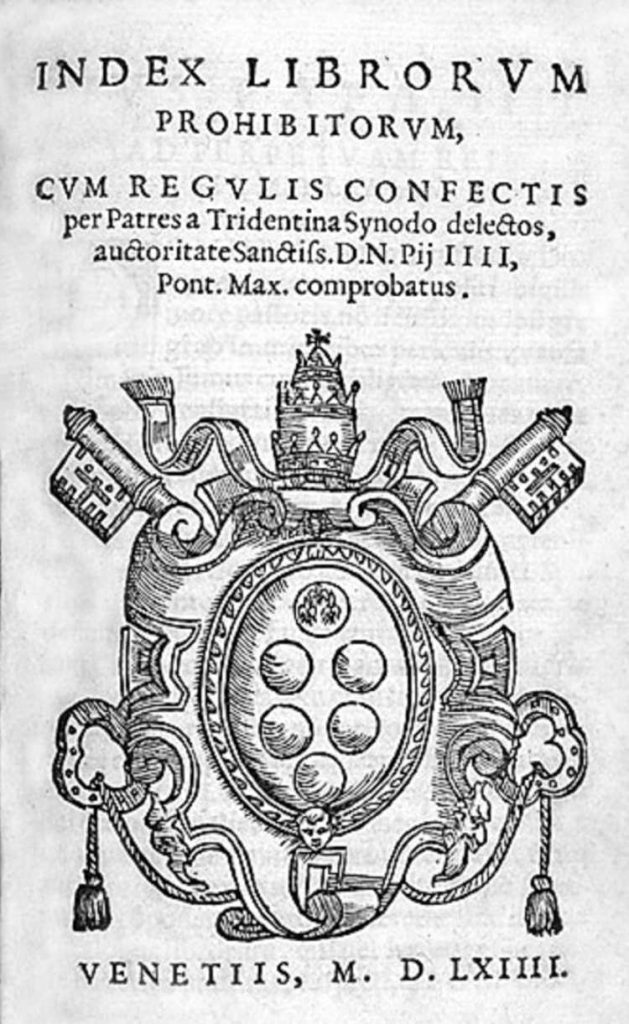
Let’s pause here. We noted earlier that in Manuscript Culture, writing was monopolised by rulers and clergy, and that information and communication were manipulated. Print partially democratised literacy, but looking particularly at religion, we can see that various prohibitions were still applied. The Reformation triggered a Counter-Reformation, and Catholics got into the reading and writing business as well. During and after the Counter-Reformation, Catholics embraced the press as long as it was used to publish approved texts. The Papacy, however, regularly printed lists of forbidden texts so everyone would know which books were bad: the famous and fear-inducing Index Librorum Prohibitorum (Index of Forbidden Books). If you had printed, owned or read a book on the Index, you could expect a summons from the Inquisition. Catholics took printing and reading seriously. Interestingly, the Index was not abandoned until 1966, not that anyone had asked for it to be.
The unique intersection of capitalism, bureaucracy, and reading religion in early modern Europe thus gave rise to the world’s first Print Culture. Gutenberg opened the first recorded printing press in Europe in 1439 in Mainz, Germany. Within the next 50 years, the number of presses in Western European cities reached 110. By the end of the 16th century, printed books were being found outside the continent as well. The first complete book printed by modern methods was Gutenberg’s famous 42-line Bible of 1454. By the end of the 16th century, it is estimated that between 150,000 and 200,000 works had been published.
By the 1600s, there were roughly three books per person in Europe. But they were not evenly distributed. Until the 18th century, only the wealthy could buy books, and reading was largely their domain. Those with fewer means had access only to cheap printed materials produced for them. The introduction of the first weekly newspapers (the first appeared in Paris in 1631), their gradual reduction in price over time, and increases in schools, students, and reading instruction all contributed to rising literacy rates across different layers of society.
Those in power made considerable efforts to control printing and its activities. But these efforts tended to backfire, as large-scale censorship and monopolisation could be extremely costly. Pirate printing continued to flourish. If even 1 in 100 presses escaped censorship, that meant thousands of books reaching the market from that press alone, which meant rulers losing control. England in particular applied systematic censorship, yet by the 17th century, one in every three books on the market in England was illegal.
“…very many, aswel Stationers and Printers, as others of sundry other professions not free of the Stationers Company, have taken upon them to set up sundry private Printing Presses in corners, and to print, vend, publish, and disperse books, pamplets and papers, in such multitudes, that no industry could be sufficient to discover or bring to punishment all the several abounding Delinquents” — From An Ordinance for the Regulating of Printing, English Parliament, June 1643
The concept of the printing press was therefore more resistant to censorship than previous communication tools. The Reformation, the English Revolution, the Dutch Revolt, the American Revolution, and the French Revolution that followed all gave rise to the idea of a free press.
As the concept of press freedom began to spread, books, newspapers and other printed materials circulated rapidly across the world. This proliferation of information led to the equally rapid spread of diverse ideas and viewpoints. Ultimately, the compulsory “sharing” ethos of Speech Culture, followed by the hierarchical “us and them” of Manuscript Culture, gave way in Print Culture to the concept of “tolerance”.
Homo Videns: The Watching Human
Plato didn’t like artists, and he feared theatre actors. Because the work they presented corrupted people. Theatre, after all, claims to show us the richness of life, and it does it well enough to convince the audience. When spectators see someone suffering on stage, they feel genuine suffering, yet they enjoy watching it. In Plato’s view, the more people watch theatre, the more they will begin to behave like the actors on stage, in unreal ways. Theatre actors, therefore, cause a moral decline in the state, and if such a decline is to be avoided, those actors must be expelled.
This might sound somewhat outdated to modern ears. But Plato’s fears on this subject were not entirely unfounded. The audiovisual communication tools that spread from the mid-20th century onwards made it possible for almost everyone to see almost everything. As Plato had predicted, this caused people to lose control of themselves, in a sense.
People naturally prefer seeing and hearing. Because compared to activities like reading and writing, seeing and hearing (in terms of consumption) are practically costless. There is an insatiable appetite for it. Throughout history, this appetite has been suppressed in various ways and has transformed over time.
Around 40,000 years ago, our ancestors were drawing pictures of objects and making sculptures. The subjects of these productions overlapped with the topics that attract the most interest today: sex, food, drink, power, wealth, war, and violence. The 25,000-year-old Venus of Willendorf, unearthed by archaeologists as a direct depiction of a nude woman, is one piece of evidence. Representational art on sexual and other provocative subjects can be found across the centuries that followed.

The widespread production of these kinds of visually focused works was historically very difficult. The cost and skill required limited production, and consumption was tied to those same limitations. Demand for visual and auditory stimulation was high, but supply was extremely scarce.
Think back to Manuscript Culture. In that period, demand for reading and writing was low because it was costly, and supply was also low due to that cost and the desire for monopolisation. But with Print Culture, supply increased even as demand remained low, which in turn helped stimulate demand. Demand for visual and auditory stimulation, however, had always been high by human nature. In Manuscript Culture and earlier periods, low supply didn’t suppress this appetite. The printers who had become experts at reducing costs following the invention of the press were the first to find a solution to this hunger.
From the earliest days of print, publishers had noticed that illustrated written materials increased sales. So they began supplementing printed texts with engravings. The subject matter of those engravings was dominated by the topic of greatest public interest: immorality. Remember the famous words of Jean Baudrillard:
“The body sells. Beauty sells. Eroticism sells.” — Jean Baudrillard, The Consumer Society
Because the realism of the engravings determined their success, work began on better engravings and engraving techniques. One not entirely natural consequence of this was the development of photography. I say not entirely natural because the idea of mechanically recording what the eye sees was a remarkably unusual concept at the time.
Various ideas around photographic production had been developing in 17th century Europe. In 1830, a French inventor named Nicéphore Niépce brought these ideas together and succeeded in creating a permanent photographic image. Very quickly, these photographs could be reproduced cheaply and began appearing in printed materials such as newspapers, magazines and books.
Alongside photography, significant developments were also taking place in sound. The first device capable of recording sound was Édouard-Léon Scott’s phonautograph of 1857. Edison’s phonograph cylinders (1880s) and Émile Berliner’s gramophone discs (1890s) followed, and sound recording began to establish itself as a commercial product.
When asked “who invented the radio?”, Guglielmo Marconi is usually the first name that comes to mind. But Marconi was the person who patented the radio; attributing its invention to a single person would not be entirely accurate. The components of radio were the result of work by multiple scientists: David E. Hughes (1879), Heinrich Rudolf Hertz (1887), Nikola Tesla (1893), Oliver Lodge (1894), Jagdish Chandra Bose (1894), and Alexander Popov (1895) can all be credited as the inventors of radio.
The same can be said of television: Paul Nipkow (1884), Vladimir Zworykin (1923), John Logie Baird (1925), and Philo Farnsworth (1927) can all be named as its inventors. The first commercial television broadcasts didn’t happen until the 1930s, and widespread adoption came only in the 1950s.

Once the potential of audiovisual technologies was recognised and turned into an industry, audiovisual communication tools spread faster than any previous communication tool in history. By the 1920s, gramophones and records had become ordinary household items. In 1923, 125,000 radio licences were issued in the United Kingdom. Twenty years later, that figure reached 10 million per year. In 1930, 65% of the US population went to the cinema at least once a week. In 1947, 15,000 television licences were issued in Great Britain. Twenty years later, that figure had exceeded 14 million. Compared with the spread of previous communication tools, these numbers show just how quickly audiovisual media reached mass adoption.
Manuscript Culture had taken 175,000 years to become established, and even then it hadn’t spread widely. Print had taken roughly 1,000 years to spread. Audiovisual tools, by contrast, reached the entire world in just 20 to 30 years. Why? There are two fundamental reasons. First, modern states and various organisations were able to supply audiovisual communication tools to the masses cheaply. Second, and more importantly, human nature: people liked watching and listening because it was costless and satisfied their emotional hunger.
Because of their ability to speak directly to human desires, audiovisual communication tools had a profound effect on societies. In this period, communication tools like television and radio ceased to be merely communication devices and became entertainment tools. The commercial availability of television sets, radios, and walkmans made it easy for every household to own at least one. Concepts like individuality and privacy became increasingly prominent in this period.
In short, audiovisual communication tools offered people an exchange of experiences that had previously been unimaginable, expanding the horizon of human experience. This gave rise to a form of pluralism known as “multiculturalism”. This was, in essence, Print Culture’s lesson of “tolerance” adapted to a new media ecology. Where tolerance emphasised similarities between the “us and them” of Manuscript Culture, multiculturalism emphasised the differences. Tolerance sought to remind people that, however different they were, they were ultimately united; multiculturalism insisted that “diversity” needed to be preserved now and forever. Tolerance was based on allowing certain behaviours; in multiculturalism, those allowances had almost no limits.
Homo Somnians: The Dreaming Human
Plato knew that most of us have no interest in truth. In his view, philosophers possessed both knowledge of the way and the will to follow it; most people had neither. We are content to live in pleasant delusions, far from truth. And so we create imaginary worlds (in his words, “theatre plays”) that troubled him greatly. In short, we escape from reality.
If Plato were alive today, he probably wouldn’t be surprised by what we do with the internet. Because in the vast world we call the internet, we see the reflections and shadows of real people. We don’t even question the concept of reality, because not knowing reality only strengthens the illusion. All that matters is that it gives us gratification and offers us a satisfying virtual reality.
We are all now living through the important transformation the internet has brought to how we communicate with one another. The internet has significant effects on how we behave and on our ideas about what is right and wrong. Where Plato urged us to seek truth, the internet opens doors to entirely different purposes.
Before turning to the development of the internet, it’s worth noting that the technologies underlying it existed long before the internet itself, and that this was a gradual process. The real beginning of the internet story goes back to 16th-century Europe and the Scientific Revolution, because it was here and at this time that the project that would eventually lead to the internet was first conceived in its modern form. That project was the systematic collection, classification, and dissemination of knowledge for the purpose of scientific progress.
“Knowledge is power.” (Scientia potentia est) — Francis Bacon
Francis Bacon, better known for this phrase, was one of the valuable contributors to this process. In his books, Bacon outlined a programme in which everything would be collected, measured, analysed, and compared, in order to eliminate ignorance and superstition. In practice, however, it proved difficult to implement.
Bacon’s peers and followers set up various organisations to put his theory into practice. Among the results were the Accademia dei Lincei in Italy (1603), the Royal Society in England (1660), the Académie des sciences in France, the Akademie der Wissenschaft in Prussia (1724), and the Akademiia nauk in Russia (1724). These scientific societies and state-supported institutions together formed the basic architecture (library, index, article) that processed academic knowledge. This architecture remained unchanged until the internet arrived.
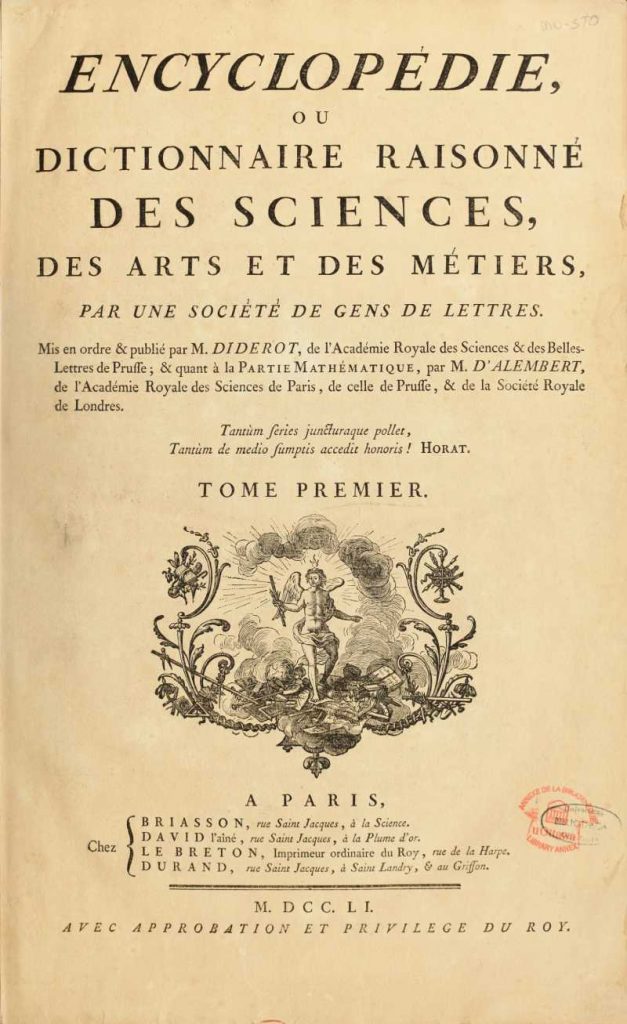
Then came the 35-volume “Encyclopédie, ou dictionnaire raisonné des sciences, des arts et des métiers” (1751), and its better-known imitator, Britannica (1768). But when it came to easy access to information, books and the printing presses that produced them proved insufficient.
New technologies aimed at making information in books more practical, such as index cards, microfilms, and microphotographs, were partially successful where print had fallen short. But in time, these too proved inadequate.
The emergence of information-processing machines brought with it some important developments. The idea of using mechanical devices to store information or solve mathematical problems was not new. The builders of Stonehenge some 5,000 years ago knew it, as did the Greeks who made calculations in the 2nd century BC to predict the positions of celestial bodies, or those who invented the slide rule in the 17th century. American engineer Vannevar Bush also knew it. In 1927, Bush built the “Differential Analyser”, a device capable of solving differential equations very quickly and accurately.
As a science administrator, Bush headed the Office of Scientific Research and Development, which oversaw the Manhattan Project and US military research during the Second World War. What made him known around the world was his 1945 article in the Atlantic Monthly, titled “As We May Think”. Remarkably prescient, the article emphasised that the poor functioning of scientific communication was a very serious problem. In his view, the print paradigm (libraries, indexes, and articles) was no longer working. Looking something up in a library catalogue was like walking down a narrow, constrained path: you could move forwards or backwards, but you couldn’t deviate from it. But according to Bush, “the human mind does not work that way. It operates by association. With one item in its grasp, it snaps instantly to the next that is suggested by the association of thoughts, in accordance with some intricate web of trails carried by the cells of the brain.”

Bush had imagined an information-processing centre capable of storing and retrieving large amounts of information, designed to match the way the brain associates data through fine “trails.” In his article, he described a concept for an electromechanical device called the “Memex”. As he described it, this device could be used to compress, store, and classify books, records, and communications in a user-centred way. Bush’s Memex concept would prove influential in the development of the hypertext system that would later pave the way for the creation of the World Wide Web.
These ahead-of-their-time ideas of Bush’s began to be realised with the help of the US Department of Defense. After the Second World War, the American military was determined to ensure there was no second Pearl Harbour. A radar system was developed against airborne attacks from across the ocean. In 1959, SAGE (Semi-Automatic Ground Environment), the world’s first computer-assisted information network, was launched to improve command and control and speed up decision-making. SAGE could quickly deliver any required information to decision-makers and assist with actions such as scrambling fighter aircraft and directing them to aerial targets.
But someone asked a question: what would happen if aircraft evaded radar and the radar system itself was destroyed? The possibility of losing their advantage this way led to the development of a more resilient network. This system, which broke messages into packets, sent them across the network via multiple paths, and reassembled them at the receiving end, was called “packet switching” over a “distributed network”.
Packet switching and distribution were working successfully. But the computers doing the switching and distributing needed to talk to each other. ARPANET (Advanced Research Projects Agency Network), which most of us know, was brought in with US government funding to solve exactly this problem (1969).
Though seen as a great invention (and it was, given it was developed to solve defence problems), ARPANET was not very useful due to the impossibility of access. The American military didn’t mind, because it had its own network and didn’t want others on it. But scientists, who believed that communication was essential for scientific progress, wanted a vast network, an “internetwork”, that would allow all scientists to communicate with each other regardless of which network they were on. With the involvement of US military interests, administrative decisions, security concerns and other factors, the establishment of this system was considerably delayed and required significant negotiation and money. Eventually, in the mid-1980s, the internetwork we call the “internet” went live, and it worked rather well. As well as the major institutions and universities in the US, there were connections overseas too.
The internet was larger and more accessible than ARPANET, but it was still difficult to use. You could exchange messages and files, and even run some programmes remotely. But if you weren’t an expert, there wasn’t much beyond that. This bothered an Englishman named Tim Berners-Lee. Working at CERN, the large physics laboratory in Switzerland, Lee’s job was to facilitate collaboration among scientists. He wanted to make the internet easier to use as a collaborative tool. In the early 1990s, Lee and a French colleague designed a system that used the internet to store, retrieve, and send documents, and called it the “World Wide Web”. With WWW, the computers themselves operated in the background, and the tasks the user wanted to carry out were in the foreground. You could jump from document to document or read whatever you liked. Those working with technical systems quickly realised the web was enormously useful and made it something of a standard.

At this stage, the internet and the web running on top of it were still little known. Those aware of and using the system were limited to people working in computing, scientists, and young technology enthusiasts. But then a group of geeks in Illinois arrived with a groundbreaking idea. First, they noticed that most people were running Windows or Macintosh operating systems on their personal desktop computers rather than UNIX, which had become a standard in the computing industry. Second, they realised these computers could connect to the internet via phone lines. Third, they knew that scientists in Switzerland had developed software enabling the sending, receiving, and storage of multimedia documents. So these university students put these three ideas together and set about creating a “web browser” that was extremely easy to use and visually clean for personal computer users. They then distributed this first web browser under the name “Mosaic”. With that, getting onto the internet and navigating it became suddenly very easy. By the mid-1990s, “surfing the internet” had become an activity as ordinary as reading a newspaper, listening to the radio, or watching television.

That is how the internet was born. Its roots were scientific. It was the realisation of a four-hundred-year dream of information being easily, effectively, and endlessly collected, stored, and processed. But over time, science yielded its place on the internet to different systemic forces: information capitalism, the surveillance state, and cultural hedonism.
Information capitalism: Industrial capitalism, a product of the 18th century, was concerned with the production of goods. Since some products still need to be industrially produced, industrial capitalism still exists. But by the 20th century, industrial capitalists had recognised two things. First, that the data-processing requirements of modern business were negatively affecting productivity and profits. Second, that the returns on research and development could be substantial. These two realisations gave a new and high value to the production, organisation, and storage of information. In Bacon’s words, knowledge could be power, but information was money. Various devices like calculators had long been on the market. But computers entered this sector very late, and the business world was largely caught off guard by the internet’s rapid spread. Even so, once they understood what the internet was, they quickly took advantage of what it offered and helped drive its growth.
The surveillance state: The power of information capitalism looked rather dim beside the power of the surveillance state. The welfare state is obliged to provide its citizens with a minimum level of goods and services. But to do so it must collect and process enormous amounts of data. As the welfare state’s responsibilities expanded to include pensions, education rights, health insurance, unemployment insurance, widows’ pensions, and all manner of other entitlements, the state’s information-processing requirements grew accordingly. IBM’s origins in producing machines to tabulate the US census between 1890 and 1900 is a good example of this.
But the need for modern states to increase their information-gathering and data-processing capacity wasn’t driven solely by the pursuit of national welfare. There were less pleasant reasons too. One was, as we discussed, finding new ways to kill more effectively and avoid being killed. This is why ARPANET research was funded by the US Department of Defense. Another was the covert state surveillance that became particularly prominent in the 20th century, carried out under the label of “state security” (though “state insecurity” would be more accurate). Governments violated the freedom of the citizens they claimed to serve by secretly spying on them. Surveillance activities thus imposed an additional burden on the state’s information-processing capacity, and the internet took on a different meaning at this juncture.
Cultural hedonism: In the first half of the 20th century, as long as bodies were clothed, speech was clean, and ideas were acceptable, it was possible to show almost anything to the public through audiovisual media. Appearances needed to be maintained. After the 1950s, however, this began to change. Hugh Hefner, who founded Playboy (1953), Aldous Huxley, who published The Doors of Perception (1954), and Jack Kerouac, who published On the Road (1957), all argued that appearances didn’t need to be maintained and that we should embrace what is real. This made them cultural icons of their era. The generation that followed embraced this idea too, and the 1960s became the years in which the transformation of moral norms took place. In the years that followed, champions of radical hedonism became the heroes of the entertainment industry. The changes of this era had paved the way for the internet. From the moment the internet arrived, people were ready for a channel through which they could listen to, watch, and say whatever they wanted. Print and audiovisual media couldn’t provide this; the internet could, and did.
Human nature and the internet
As we discussed earlier, writing and print spread very slowly, because we had a natural reluctance to read and write given their cost in terms of effort, time, and learning. The spread of audiovisual media took 20 to 30 years, because we were naturally inclined to watch and listen given that it was costless. The internet spread far more rapidly than any of them, reaching the entire world in just a few years.
As we said at the outset, the internet is not in itself a new form of communication. Like all other communication tools, it was built upon what came before. This is one reason for its rapid spread. But there is another reason: we had a motivation that made us genuinely want it. Is that really the case?

The internet is an environment that touches our desires and our evolutionary pressure points. In this sense, it surpasses all previous communication networks. Humans are designed to detect anomalies and solve puzzles. The internet offers us an endless supply of mysterious anomalies and puzzles. Everything is there: strange, unfamiliar, interesting, unusual, mysterious things. While navigating all this information, being distracted by various stimuli is a natural consequence. This is where the internet diverges sharply from books. Books focus attention; the internet disperses it. Think about how many times you’ve gone online to find one specific thing and ended up looking at a dozen other things along the way. Browsing rather than searching is one of the things we enjoy on the internet, and it’s an end in itself. This is why there are so many platforms today that stimulate our browsing instinct.
Another reason is the concept of “relevance” we discussed in the Homo Loquens section. We don’t speak to exchange information or collaborate; we speak because we enjoy it by nature. We enjoy speaking by nature because speech (the question of “relevance”) had increased our selection value long ago. Similarly, we don’t share things on the internet to exchange information or collaborate; we share because we enjoy it. When we consider that sharing on the internet is a continuation of speech by other means, we can say that “relevance” is just as applicable to the internet, since it still increases our selection value.
An example of the relevance concept: An example of relevance: consider Wikipedia. As you know, Wikipedia is a free, independent, non-commercial, ad-free online encyclopaedia collaboratively produced by its users in many different languages. So what motivates users to contribute? Money? No, contributors are not paid. Fame? No, most contributors do so anonymously or under a pseudonym. Why, then? The answer lies in evolutionary reasons: users contribute to Wikipedia because they find it enjoyable.
Another pressure point the internet touches is our desire to experience what we described earlier as “supernormal stimuli”: the sights and sounds we are pre-programmed to notice involuntarily. These include subjects of sex, food, drink, power, wealth, conflict, and violence. From an evolutionary standpoint, these stimuli always instinctively attract our attention. Now think about the internet and how much of this kind of stimuli it contains. We can say we are exposed to more of these stimuli than at any other point in history. An unimaginable variety and quantity of pornographic sites, news sites that constantly foreground conflict, violence, and death, and more. Like them or not, you look at them instinctively, and these kinds of content provoke a response and an arousal you find yourself desiring.
It is partly because of our desire to experience supernormal stimuli, which particularly explains the internet’s hold over us, that we rushed through the door when audiovisual media opened it. When the internet’s door opened, we flooded in.
With the internet entering our lives, the concept of “New Media” came into use. Speech, manuscript, print, radio, and television cultures, previously grouped under “Old Media” or “Traditional Media,” had given way to “New Media” built on the internet. This framing is not entirely accurate. Contrary to what is often assumed, “Old Media” has not disappeared and most likely never will. Historical evidence shows that fundamental communication tools are extraordinarily persistent. As we noted at the outset, new communication tools don’t replace the old ones; they join them. The internet contains within it all the communication tools that came before.
We saw earlier that each communication culture brought different changes from the one before it. We can therefore expect the internet to bring about certain social and cultural changes as well, to have transformed the social practices and values of the preceding audiovisual cultures. So what changes did Internet Culture bring?
In print cultures, everyone theoretically had the right to speak, but in practice only those who could afford the cost of printed expression truly “spoke.” In internet culture, everyone genuinely has a voice. The cost of speaking here is very low, and so everyone speaks. In short, the internet involves a radical egalitarianism. With the internet, people became not just consumers of information but producers of it. The internet has democratised communication still further.
One of the most famous cartoons ever drawn about the internet is undoubtedly Peter Steiner’s 1993 cartoon: “On the internet, nobody knows you’re a dog.”

This cartoon captures beautifully one of the internet’s other defining characteristics, and one of the changes it has brought: anonymity. In the real world, everyone knows who you are. On the internet, you decide who you are. All you need to do is create a fake profile with whatever characteristics you choose. The internet therefore offers people alternative virtual lives through anonymity. These lives give people the freedom to do things online they wouldn’t do in the real world, particularly things they shouldn’t do, without feeling guilt. Technologies frequently discussed today, such as the metaverse, Web 3.0, and augmented reality, show very clearly where things now stand in terms of decentralisation, equality, and anonymity.
In conclusion, recall Print Culture’s lesson of tolerance and Audiovisual Culture’s multiculturalism. In the Internet Age, a concept that goes beyond both has emerged: “transculturalism”, proposing an identity that exists beyond culture. This identity is not rooted in any particular historical culture but consists of a mixture of many historical and artificial cultures. Transculturalism can in some ways be seen as a variant of the cosmopolitanism of the Enlightenment’s “world citizenship.” But transculturalism has a component of “self-creation” that cosmopolitanism does not contain. Transculturalism allows for and encourages the formation of new, personalised identities. These identities encompass both real and imagined identities, online and offline.
Conclusion
Every communication tool that has emerged has largely preserved the characteristics of the tool that came before it. What changed were the cultures. Speech culture, which gave us evolutionary advantages, produced equality; manuscript culture, which gave rise to monopoly, produced the “us and them” division; print culture, which made reading widespread, produced the doctrine of tolerance; audiovisual communication tools, which spoke directly to our desires and sensitivities, produced multiculturalism; and internet culture, which offers us alternative lives, produced transculturalism.
What new changes the concept of transculturalism, produced by today’s dominant communication medium, will bring about remains to be seen over time. Because the habits we’re changing alongside developing technologies bring with them many questions that are still waiting to be answered.
Sources: A History of Communications: Media and Society from the Evolution of Speech to the Internet – Marshall T. Poe (Book), The Consumer Society: Myths and Structures – Jean Baudrillard (Book), Why We Talk: The Evolutionary Origins of Language – Jean-Louis Dessalles (Book), The Republic – Plato (Book), As We May Think, Vannevar Bush – The Atlantic, Inventing the Internet – Janet Abbate (Book), Featured Image: Morningstar