
Have you ever formed an association between a piece of music and something you were doing at the time? Has a song ever taken you straight back to the moment you first heard it? Or shifted your mood entirely?
One of the most fundamental strategies in marketing is to appeal to as many human senses and emotions as possible. Sight, hearing, touch, smell, taste — and the fear, excitement, surprise and happiness that follow from them. Marketing success is largely a function of how well those senses and emotions are understood and engaged.
Let’s look at sensory marketing and emotional marketing through a few examples.
Imagine you’re putting together an advertising campaign for an insurance company. You start building the plan around two core questions:
- Who do we want? (Defining the target audience)
- Who wants us? (Identifying the potential customers through market research)
Once the strategy is in place (skipping over the technical details), you arrive at the creative itself, where you have a very short window to make an impression. Knowing which senses and emotions your ad needs to hit is critical for making it stick.
For an insurance company, the emotion you’re trying to create is fairly obvious: Fear.
- “If you don’t take out health insurance, you’ll face enormous bills when your health fails and may never fully recover.”
- “If you don’t insure your home against fire or earthquake, you could lose everything and be left with nothing.”
- “If you don’t start a pension, you’ll be heading into old age with no safety net.”
The underlying emotion in all of these is fear. That’s what drives people to act.
Designing creatives that carry these messages in ways that directly engage the senses makes them considerably more powerful. A striking image of a collapsed building to communicate the importance of earthquake cover, or the quietly devastating image of an elderly person with nothing left — these can hit hard and push the audience towards the outcome the brand is looking for.

Most major brands today treat the senses and emotions as primary levers for driving behaviour. The specific emotions they target will vary by brand and by platform, but the underlying principle holds.
Let’s take another example.
You pop into a garden centre just to have a look around. While browsing, you catch the scent of freshly cut grass. How would that affect your inclination to stay longer and perhaps buy something?
I didn’t choose that example at random. Something very similar actually happened: a DIY retailer in Germany introduced the smell of freshly cut grass into their physical stores. The results were striking. Customer perception of the brand reportedly improved by 50%, and customers even started seeing store staff as more hardworking and more knowledgeable.
While we’re on the subject of scent marketing: a kitchenware retailer introduced the smell of freshly baked apple pie into their stores and saw a 33% increase in sales.

Sensory and emotional marketing strategies can have a significant effect on purchasing behaviour. But can the same results be achieved in digital marketing?
The sensory and emotional limit in digital marketing
In traditional marketing, engaging all five senses — sight, hearing, smell, touch and taste — is entirely possible. In digital marketing, that range is considerably narrower. “Directly” engaging smell, touch or taste is simply not feasible. “Indirect” approaches exist, but their impact is limited.
In digital marketing, sight is by some distance the dominant sense, and most platforms and content strategies are built around visual communication. There’s good reason for that.
Between 50% and 80% of the brain’s activity is devoted to visual processing: colours, shapes, visual memory, spatial reasoning. This predisposition means we naturally gravitate towards images, illustrations and video over other content formats.
The average person processes visual content 60,000 times faster than text. We retain around 80% of what we see, compared to just 20% of what we read. That’s a substantial difference.

Given those numbers, a visually-led marketing strategy is entirely logical. But focusing exclusively on sight means missing a more holistic approach to the senses.
I mentioned that smell, taste and touch can’t be engaged directly in digital marketing. Sight is dominant. That leaves one core sense: Hearing.
Hearing tends to be underestimated in digital marketing, pushed to the background by the pull towards visual-first thinking. But it deserves considerably more attention than it usually gets.
You’ve probably had the experience of a piece of music transporting you somewhere else entirely. Or heard a song you knew from years ago and found yourself instantly back in the emotional state you were in when you first heard it.
Let me share a personal example.
Last January, I was in Southampton for work — the port city where the Titanic set sail from. After the work was done, and missing the sea after living inland, we decided to take in some sea air before heading back.

We ended up in the open car park right on the waterfront at Mayflower Park, and because of the cold and the pandemic, we stayed in the car and just watched the sea. While we were sitting there, a song came on — “Kati Mou Krivis” by Greek singer Orfeas Peridis. I liked it so much I noted it down to listen to again later.
I still listen to it now, along with his other songs. The interesting thing is that whenever I put it on, I’m immediately back in that moment, completely and fully — even though nothing particularly eventful happened, just watching the sea and the birds. I can see the sea, smell the salt air, hear the gulls. The style of the music even brings the Aegean coast of Türkiye to mind.
I may have romanticised that example slightly 🙂 But what stays with me is how a piece of music can pull you entirely out of your current emotional state and place you somewhere else — somewhere you haven’t physically been for a long time.
So what’s behind that? And what does it mean for marketing?
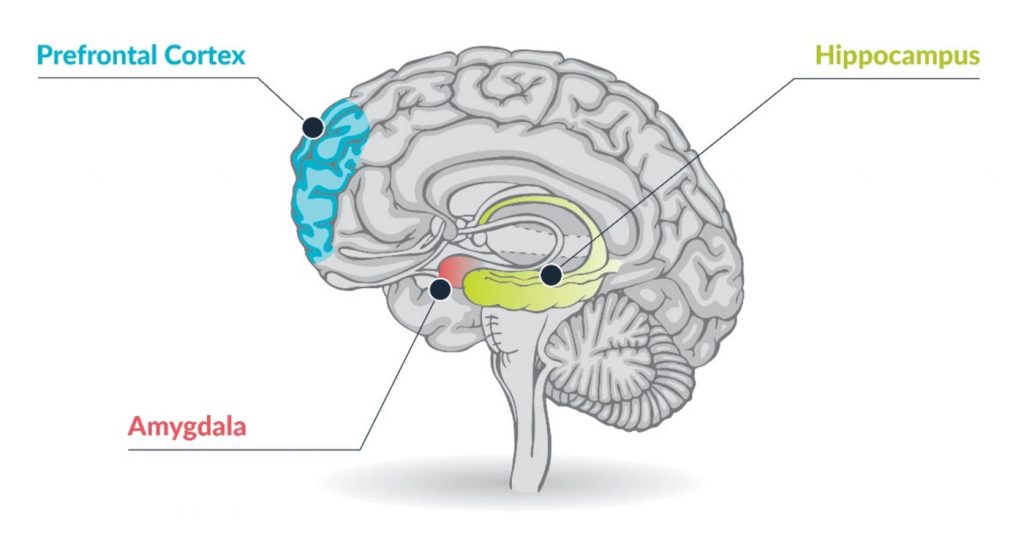
Music embeds itself in memory more effectively than most other information because it contains rhythmic structure. The hippocampus and frontal cortex, located within the limbic system, are the brain’s primary memory centres (along with the amygdala for emotions). These regions are constantly processing the information we encounter. But that process isn’t always straightforward — we can’t simply decide to memorise something on demand. Music, because of its regular rhythmic structure, helps. It makes the experiences we associate with it easier to store and retrieve. In short, music makes memories stick.
You’ll have encountered music used in retail environments many times. In upmarket shops selling premium products, the music tends to be calm and unhurried. In busy, high-turnover environments — fast food restaurants, for instance, or shops with table limits — the music is more upbeat. This is rarely accidental. Luxury purchases require time and deliberation, so slower music encourages customers to linger. High-turnover environments need to keep people moving, so faster music nudges them towards action.
The same logic applies in digital marketing. Engaging the auditory sense increases memorability just as effectively as any other approach.
One example I can speak to directly is a promotional film produced as part of the Go Türkiye project (formerly known as Turkey Home), on which I worked as a consultant. Directed by Dağhan Celayir and released under the title “Home of Turquoise” across dozens of countries, the film won numerous awards and drew considerable attention for its music.
Alongside the score, the film incorporated natural sounds — water, waves, sand, wind — which added a layer of sensory richness that the music alone couldn’t fully achieve.
The score was composed by the acclaimed composer and musician Marios Takoushis. You can watch the behind-the-scenes video below.
Another strong example of music’s role in digital marketing is the John Lewis’ Christmas advertising campaigns. John Lewis has become something of an institution in the UK when it comes to “Christmas”, and the music in their ads is a significant part of why.
The calm, emotionally resonant tracks used in their films have reached the top of the UK charts, been covered by numerous artists, and even inspired a children’s book. The music isn’t incidental — it’s central to the campaign’s success.
There are many more examples. The point is that music’s place in marketing is too significant to ignore. Its effects, both short and long-term, are real:
- It surfaces emotion: Music activates a wide range of emotional responses in the brain, often simultaneously.
- It enriches the story: The narrative you’re telling becomes more complete when music accompanies the visuals. The overall experience deepens.
- It drives action: Just as a national anthem stirs a sense of duty and belonging, music more broadly has its own way of motivating people and making them more receptive to acting.
- It integrates with the brand: Just as colours, fonts and design choices become associated with a brand over time, so does music. A track that fits the brand identity reinforces brand awareness and strengthens brand recognition.
Conclusion
Building an effective marketing strategy means understanding that the path to success runs through human emotion and the senses. It means understanding psychology and planning with that in mind, holistically. Sensory marketing and emotional marketing matter precisely for this reason.
In digital marketing, where only two of the five senses can be engaged directly, developing strategies that speak to the ear as well as the eye — and using music specifically, not as an end in itself but as a genuinely powerful tool — will meaningfully increase both brand awareness and memorability.
Sources: Emotional Intelligence: Why It Can Matter More Than IQ – Daniel Goleman (Book), Why does music evoke memories? (BBC Culture), Why do people prefer visual content? (Neosperience), What a scent marketing strategy can really do? (ScentAir)