
There’s no denying it: with 1.65 billion users, Facebook remains the number one marketing platform across virtually every industry. The sheer scale of its reach, combined with genuinely useful features — page structures, post formats, engagement variety, advertising options — makes it the default first choice for brands, businesses, and publishers alike. Everyone wants to reach more people, and ideally without paying for the privilege. So the scramble for organic reach is very much real.
But the moment you say “organic reach” out loud, Facebook reveals a rather different face: the News Feed Algorithm.
It used to be so simple
Let’s start with a few numbers:
- Total global internet users: 3.4 billion
- Facebook monthly active users: 1.65 billion+
- Facebook users as a share of all internet users: ~48% (nearly half the internet)
- Total Facebook pages: 50 million+
- Average number of friends per Facebook user: 155
- Average daily posts per Facebook page: 1.48
- Average time a user spends on Facebook per day: 22+ mins
- Average number of pages liked per user: 40
Now, run those numbers together — without any algorithm in place — and a fairly obvious problem emerges.
A typical user spends 22 minutes a day on Facebook. In that window, they’re theoretically exposed to posts from 155 friends and 40 pages they follow. The probability of them actually seeing everything? Near zero. Rounding down generously, you could say it’s exactly zero.
This wasn’t just a problem for users. It was a problem for Facebook too. Users were missing content from people they actually cared about, while Facebook watched brands spam the chronological feed — and couldn’t extract much value from any of it. Everyone was losing, just in different ways.
Then Facebook rode in with an algorithm
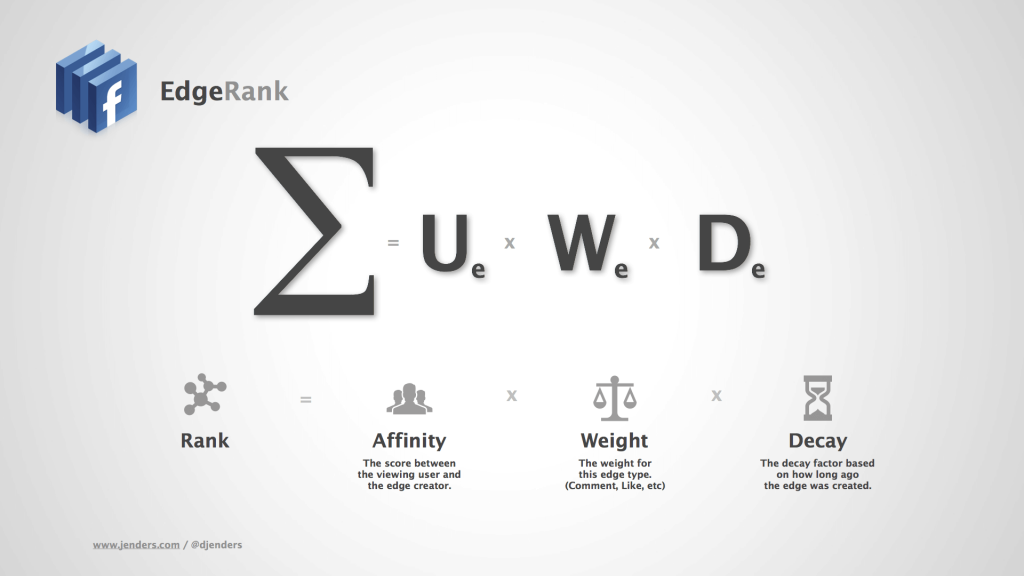
The News Feed Algorithm was the single biggest structural shift Facebook ever made to its platform. It addressed both problems at once: users started seeing posts from the people and pages they actually engaged with most, rising to the top of their feeds. Pages that wanted broader reach were nudged — firmly — towards paying for it. A win-win, Facebook called it. Users got relevance, Facebook got revenue.
Publishers, of course, had other words for it.
Publishers? What publishers?
Publishers trying to drive traffic to their sites were arguably the group hit hardest by the algorithm. Pre-algorithm, the logic was straightforward: post more, get more traffic. Post-algorithm, that approach collapsed almost overnight, and anyone who wanted meaningful reach had to get considerably more creative.
In the UK and US, this pushed publishers towards better content strategies. Elsewhere — and this was particularly visible in certain markets — it pushed people towards considerably more creative tactics: “Like if X, comment if Y, share if Z.” “Don’t forget to tag your friends.” “Say Amen.” (Yes, those posts. Yes, they still exist.) Mercifully, subsequent algorithm updates began quietly strangling that kind of content, which felt like justice.
Facebook’s official response to all the complaints from page owners was, essentially, that the algorithm was designed entirely with users in mind — a perfectly convenient position that conveniently happened to benefit Facebook’s ad revenue as well.
Over the months and years that followed, the News Feed Algorithm went through countless iterations. Metrics like content type, time spent viewing a post, personalisation settings, and actual reading time (farewell to every clickbait merchant who built a business on headlines alone) were gradually folded in.
New update, new headache
Which brings us to the update Facebook announced on 29 June 2016 — the one that’s the real subject of this piece.
Unlike previous updates that tended to affect specific content types or behaviours, this one is explicitly aimed at all publishers. News sites, live streaming pages, content creators — everyone is in scope.
So what will actually change?
The framing Facebook chose for this update centres on a familiar-sounding idea: friends and family.
Users will start seeing more posts from their personal connections — friends, family — and relatively fewer from the pages they follow. Facebook is calling this a “friends and family first” approach, which is either a genuine product philosophy or the most well-dressed way of saying “you’re going to need to buy ads now” — probably both.
On the impact to pages, Facebook is cautiously diplomatic: “This update may cause some Pages to see their reach and referral traffic decrease.”
The key word here is “some.” But which “some” pages?
Facebook elaborates:
“Pages whose posts are shared by users, and then further liked or commented on by their friends, will see less of an impact. Pages whose traffic comes primarily from their own direct posts will see a larger impact.”
Translation: if your content spreads through genuine sharing and conversation, you’ll be mostly fine. If you’ve been relying on broadcasting directly to your followers and calling that a traffic strategy — that’s the bit that’s going away.
To put it in Facebook’s own charming phrasing: “We’re not saying don’t post — by all means, post as a hobby.”
What about Instant Articles?
In my previous post, I covered Facebook Instant Articles and the broader ecosystem of content display platforms. At the time, I flagged some thoughts on how Instant Articles might interact with the News Feed Algorithm going forward.
Notably, the announcement around this latest update makes no specific mention of Instant Articles. My personal read: publishers using Instant Articles are likely to maintain a modest edge over those who aren’t. Facebook has invested too much in that product — and it genuinely benefits users, publishers, and Facebook — to leave it without some degree of preferential treatment in the algorithm. But that’s speculation, not confirmation.
To Wrap Up
Facebook’s never-ending stream of algorithm updates is starting to feel less like gradual refinement and more like a sustained renegotiation of the deal it once offered publishers. Whether the outcome is a new wave of publishers begging their audiences to share everything — or a quieter shift towards genuinely better content — remains to be seen. As does the question of whether Facebook will eventually walk back some of this, as it has done before.
UPDATE: About an hour after I published this post, a Facebook ad appeared in my own News Feed promoting page reach. I’ll just leave that here without further comment 🙂
