As technology has advanced, the way we communicate, the way we express emotions, our habits and behaviours — our lived experience in general — has changed. We all know this, see it, and live it. We can access whatever information we want, wherever we want, whenever we want, and consume it instantly. Whether this is an advantage or a disadvantage is debatable; one outcome, for instance, is that the concept of “patience” is slowly losing its meaning. In an age where we can barely tolerate waiting for anything, we want information to move at speed. We want to communicate faster and more efficiently, and to express our feelings in more immediate, concrete ways.
Emojis, which have become — for want of a better phrase — “a communication language” in their own right, are precisely the kind of thing worth examining in this context.
Those of you who read my post “Emojis in Communication: What They Mean and Where It All Goes Wrong“ will remember that I looked at emojis from a technical perspective, covering the fact that the same emoji can look different across platforms and devices, and that those visual differences can result in different meanings being attached to them. In this post, I want to look at something slightly different: the universality of emojis and their relationship with different cultures.
Emoji as a communication language
Whether it’s fully accurate to call emojis a “communication language” is debatable, but there’s no question they’ve become a significant part of how we communicate today. According to Adobe’s 2019 report, people who use emojis tend to be perceived as warmer and more approachable, which might make “a language of sincerity” a more fitting description.
More than 10 billion emojis are shared every day around the world. Why? What is it about emojis that we’re so drawn to? What lies behind their global ubiquity?
Note: The word “emoji” is often associated with the English word “emotion,” which makes a certain intuitive sense, but is actually a coincidence. Japanese designer Shigetaka Kurita coined the word “emoji” in 1999 from the Japanese words for “picture” (e) and “letter/character” (moji).
Emojis are, in evolutionary terms, well-suited to satisfying human desires. The ability to convey an entire message in a single icon makes them a natural choice for a human brain that is always inclined to take the path of least resistance. The brain likes easy. Emojis are easy.
A 2011 study on how we perceive emojis gives us some insight into what’s happening when we use them. Participants read texts with and without emojis while their brain activity was monitored using fMRI. The findings showed that the human brain processes emojis as non-verbal communication/information rather than as text. We categorise them as emotional communication. This goes some way to explaining why emoji-laden messages can carry so much weight.
Another study published in 2019 looked at the relationship between emojis and human faces. It found that receiving an emoji during communication triggers neural responses in the brain similar to those produced by face-to-face interaction.
When you factor in that the human brain processes images in as little as 13 milliseconds, it becomes easier to understand why something that communicates entirely through visuals has embedded itself so thoroughly into everyday communication.
Are emojis universal?
The debate is ongoing, but many people hold the view that music is a universal language. A 2019 Harvard study largely supports this. But it’s not quite as clear-cut as “two plus two equals four”. Unpacking what “universal” actually means requires careful consideration of linguistic concepts and cultural differences.
The same applies to emojis. The differences they carry, both in meaning and technically, pull them away from true universality.
On the technical side, briefly: as I covered in “Emojis in Communication: What They Mean and Where It All Goes Wrong“ emojis are designed differently across platforms and devices, which means the same emoji can look different to the sender than it does to the recipient. Someone sending what they think is a happy face might be sending something that reads as sad or neutral on the other end, simply because of design differences.
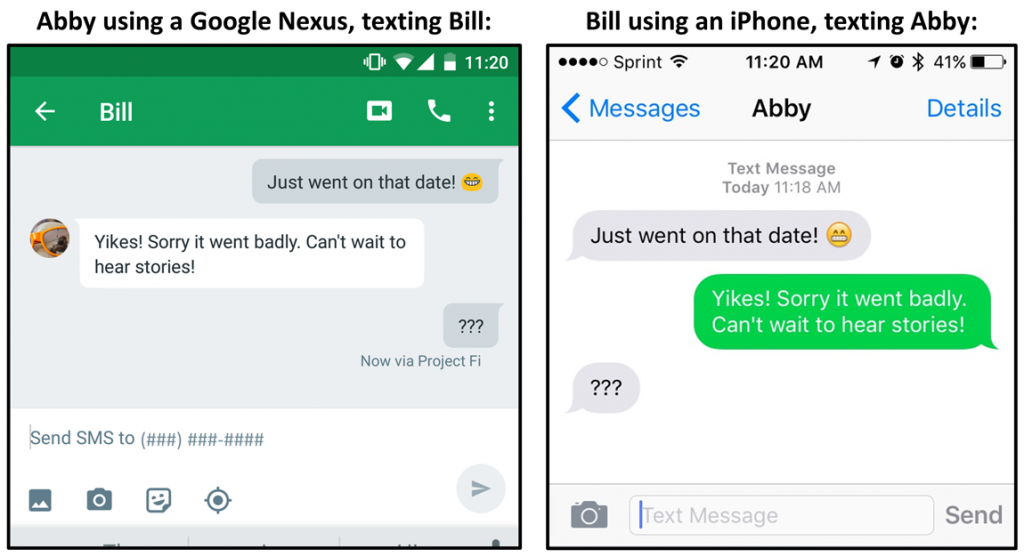
This happens because emoji visuals vary by platform and device. Emojis are determined and standardised by the Unicode Consortium, so in that sense a universal standard does exist. But that universality is purely technical. The moment you’re talking about what the emoji actually looks like, and therefore what it means, that universality breaks down.
When we look at emoji universality through the lens of meaning and culture, we move into quite different territory. Because this is where the different sensitivities of different cultures come into play.
Before emojis, as you’ll know, certain expressions were formed using combinations of keyboard characters: “:” and “)” for a smile, “:” and “@” for anger, and so on. Even in these very simple character combinations, cultural differences were visible.
You can see this clearly when comparing Eastern and Western emoticons. Take a look at the comparison below — what do you notice?
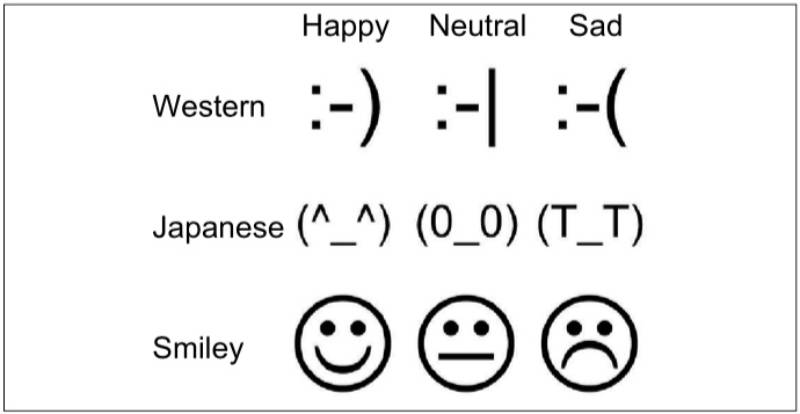
The most immediately obvious difference is that one set reads horizontally and the other vertically. But the more interesting difference lies in what changes and what stays fixed as the expressions vary. In Western emoticons, the eyes remain constant while the mouth changes. In Japanese emoticons, it’s the opposite: the mouth stays fixed and the eyes change. The same pattern holds for most other East Asian countries. Why? Social psychologist Masaki Yuki of Hokkaido University explains it in a 2007 paper:
“Because the eyes are more difficult to control than the mouth when expressing emotions, people in cultures where emotional suppression is the norm (such as Japan) focus on the eyes rather than the mouth when interpreting others’ emotions. Conversely, in cultures where open emotional expression is the norm (such as the US), people tend to interpret emotions based on the position of the mouth.”
Cultural differences in how emotions are physically expressed, in other words, show up clearly in digital communication too.
Now let’s look at a February 2022 study. Based on data gathered from 9 million geotagged tweets, it maps the most commonly used emojis around the world.
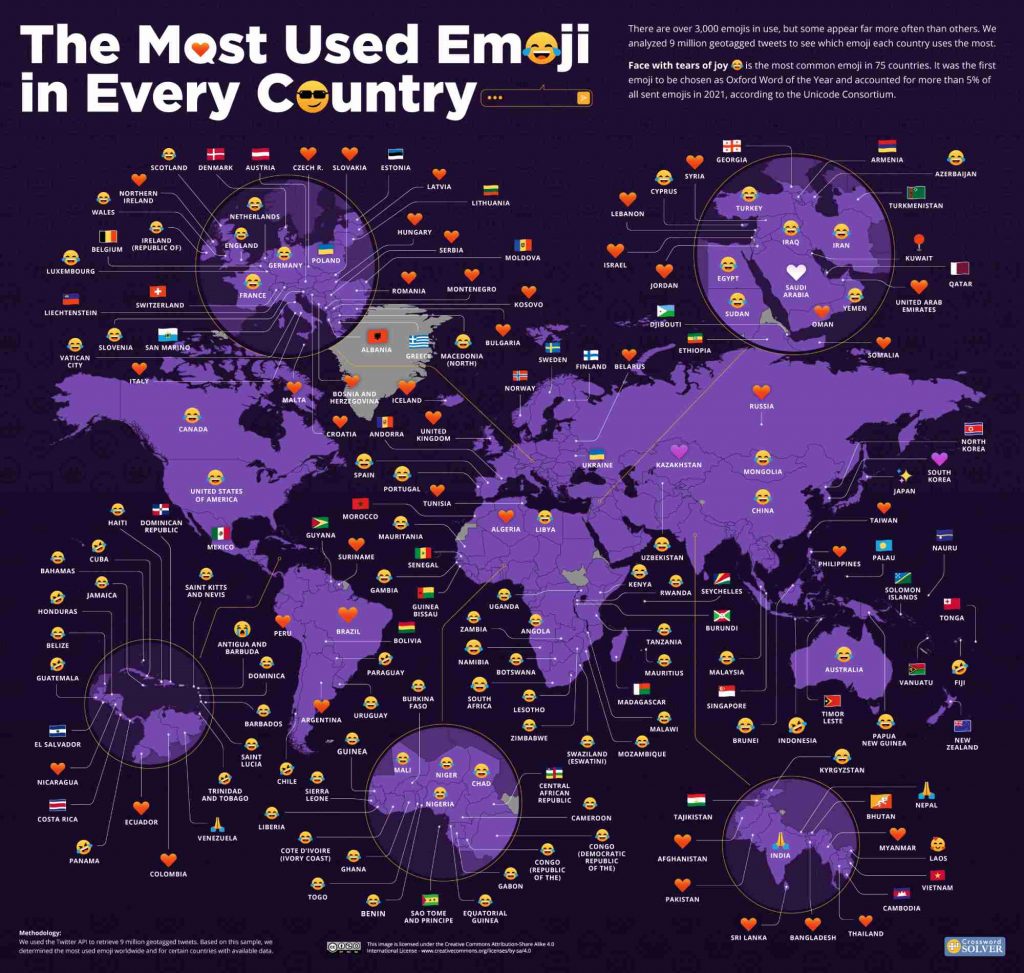
According to the research, the red heart (❤️) and the crying-laughing emoji (😂) rank among the most used emojis globally. A quick look at the map confirms this.
But did anything else on that map catch your eye? Let me save you the squinting: just look at Saudi Arabia. Instead of the red heart used almost everywhere else, you’ll see a white heart (🤍).
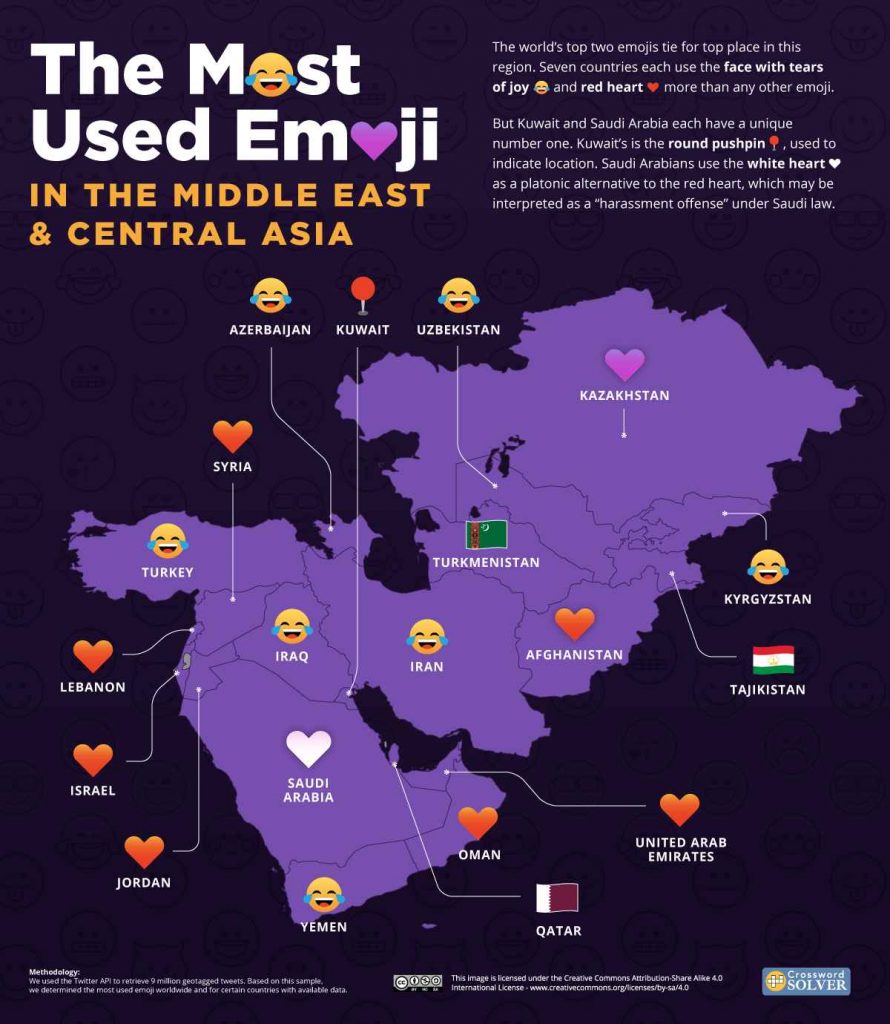
Why does most of the world use the red heart while Saudi Arabia uses the white one? This is precisely where cultural differences become significant. In Saudi Arabia, sending a red heart emoji via WhatsApp is associated with “harassment” and can be treated as a criminal offence. If found guilty, the sender can face up to five years in prison or a fine of 100,000 Saudi riyals.
The Saudi Arabia case might seem like an isolated exception, or a rule specific to WhatsApp. But given that the emoji study in question covered only Twitter, it’s fair to say the impact of that ruling has extended beyond WhatsApp and seeped into broader communication culture.
These differences in meaning aren’t limited to legally enforced exceptions like the Saudi Arabia case. In China, for instance, you might want to think twice before sending the angel emoji (👼). While it represents “innocence” and “goodwill” in most countries, in China it carries connotations of “death” and “threat”. The clapping emoji (👏), often used to express congratulations, can also mean something quite different in China — specifically, “a sexual act” — due to phonetic association.
The thumbs up (👍) is another one to use with care, depending on where you are. While widely understood as a sign of approval, in Greece (and in some Middle Eastern countries) it can be read as an “insult”.
In Japan, the poo emoji (💩) is used to mean “good luck”. I realise this might be slightly off-putting, but I should also mention that it’s used to mean “chocolate ice cream”. Burger King even ran an ice cream campaign built around exactly this double meaning:
Now, what comes to mind when you see this emoji: 🤟? For most people, it’s the rock sign, the “metal salute”. We tend to assume its meaning is universal. But it isn’t. This emoji represents the “I love you” sign in American Sign Language, and the Unicode Consortium’s own description defines it by that meaning.
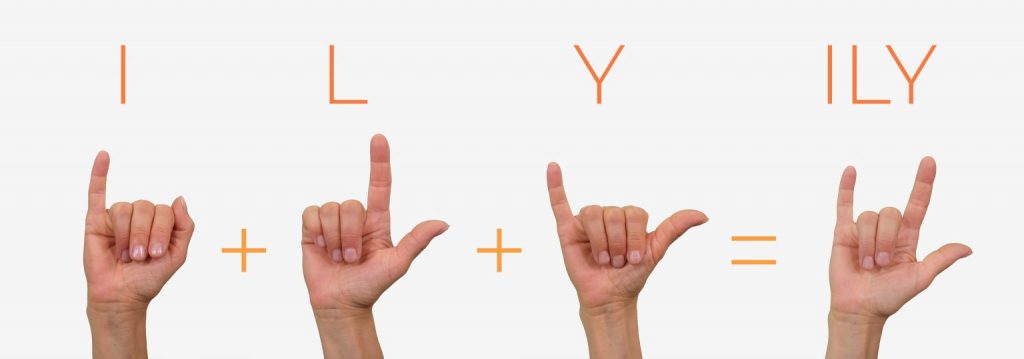
The emoji that’s actually meant to represent the “metal salute” is this one: 🤘. But use that one in Italy, Portugal, Spain, or Colombia, and you may get a very different reaction — because in those countries, it can mean “being cheated on (by one’s partner)“. Interesting, but true.
As these examples make clear, and we could list many more, the same emoji can carry completely different meanings across different cultures — sometimes directly opposite ones. Given all of this, it’s safe to say that while emojis have achieved a kind of technical global standard, their claim to universality falls apart the moment meaning enters the picture.
Conclusion
Saying “music has syntax, and so does language, therefore music is a universal language” — accepting music as universal purely because it has syntax — would not be entirely accurate. By the same logic, accepting emojis as universal simply because they’ve been standardised by the Unicode Consortium would be equally wide of the mark.
That said: perhaps think twice before enthusiastically accepting congratulations from your Chinese acquaintances (👏). Better safe than sorry 🙂
Sources:
- The Cultural Phenomenon of Emoji – Adobe
- 6 Facts About Emojis Found Using New Analysis – Brandwatch
- Emoji – The Museum of Modern Art
- Perceptual decisions are biased by the cost to act – eLife
- Brain activity when reading sentences and emoticons: an fMRI study of verbal and nonverbal communication – Wiley Online Library
- Cortical processing of human and emoji faces: an ERP analysis – Taylor & Francis Online
- In the blink of an eye – MIT
- Music everywhere – The Harvard Gazette
- Are the windows to the soul the same in the East and West? Cultural differences in using the eyes and mouth as cues to recognize emotions in Japan and the United States – SciendeDirect
- The Most Used Emoji on Twitter in Every Country – Crossword Solver
- Saudi Arabia: Sending red heart emoji can land people in jail for 5 years – The Siasat Daily
- Is Music a Universal Language? – Psychology Today
- Why emoji mean different things in different cultures – BBC
- Don’t even think about using these emoji in these countries – Mashable