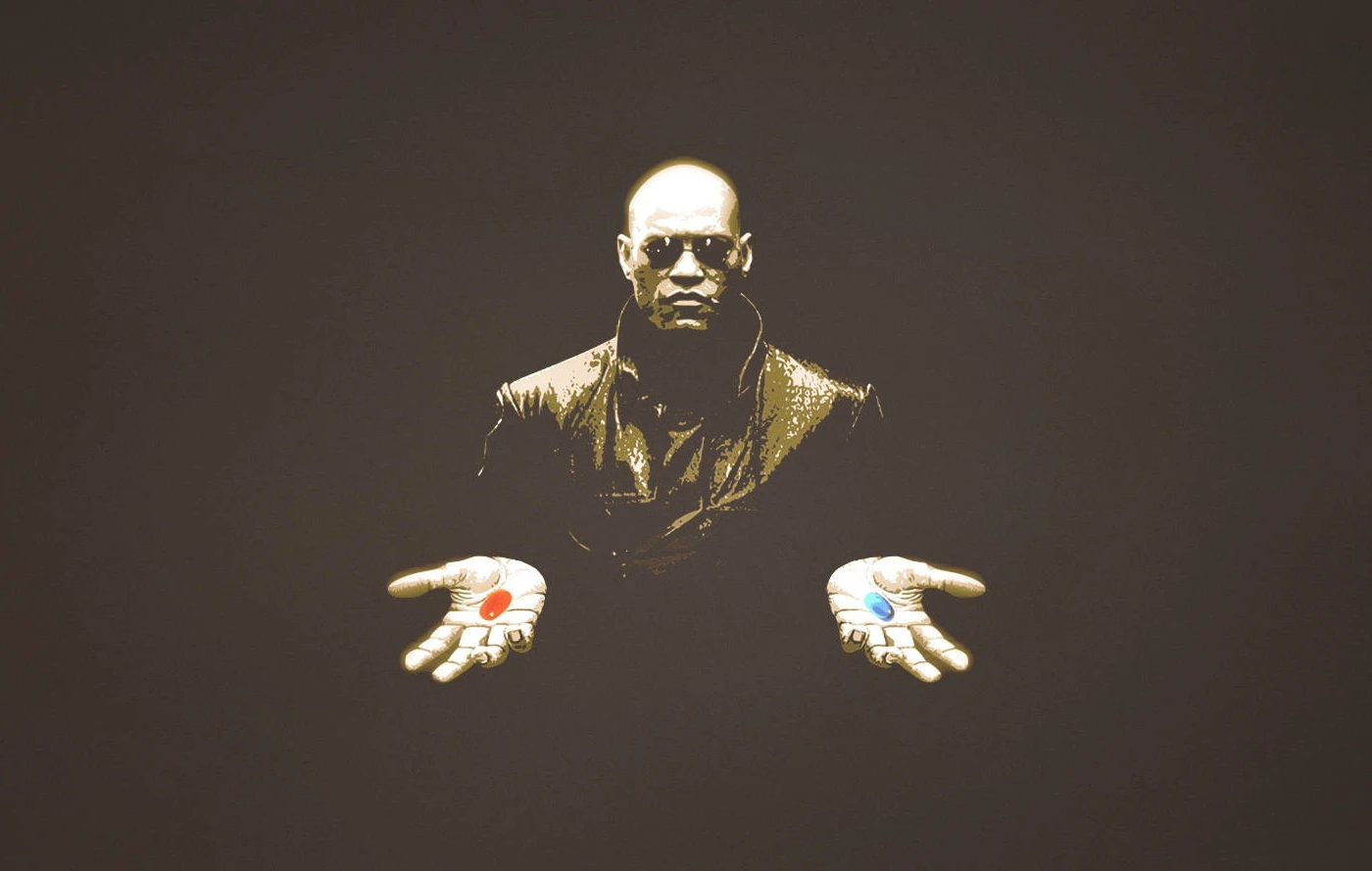
In The Matrix, Neo is offered two pills. The blue one keeps the illusion that everything is fine. The red one shows him the truth. This article isn’t a red pill offer. It’s just a question: how many decisions have you made since waking up this morning? And how many of those were really yours?
In our daily lives, we encounter many factors that influence our decisions. For instance, the fact that it’s raining on the day you planned to go for a walk might make you abandon the idea altogether. Or that car you’ve been researching for ages and finally decided to buy might suddenly drop off your list because of a single negative comment from a close friend. Or a job offer from a company you really wanted to work for might turn into something you resent, simply because of the salary on offer. We could go on with examples like these.
These factors usually push us to question, and partly understand, what actually matters more. Is it the walk that matters, or staying dry? All the data you’ve gathered from your car research, or your friend’s offhand opinion? Being part of the company you really wanted to join, or the size of the paycheck?
When it comes to important decisions, things get a bit more complicated. How should the decision be made, and on what basis? In situations like these, you might need to ask yourself a few key questions.
The 10/10/10 rule
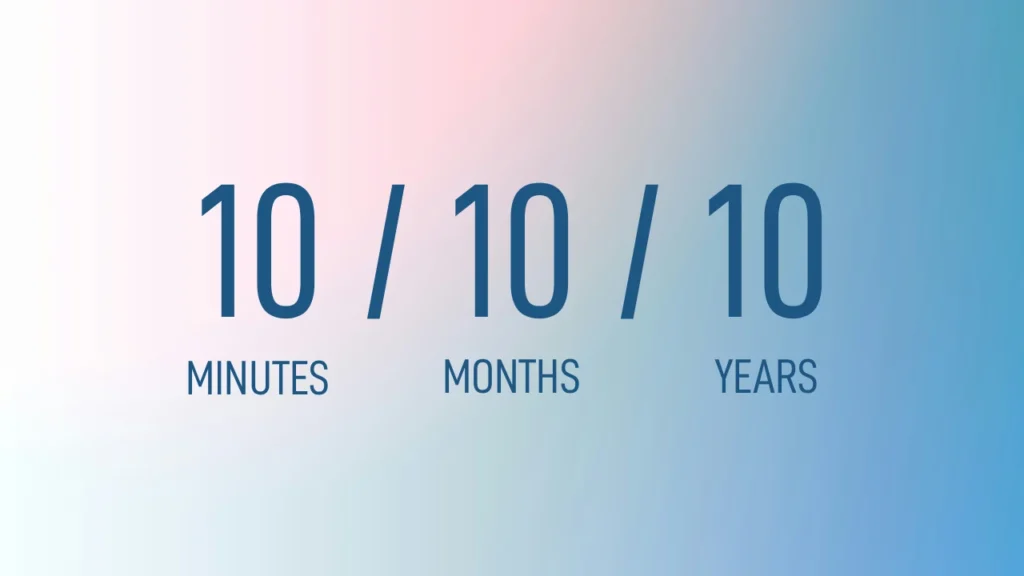
American author Suzy Welch, in her book of the same name, talks about a rule she calls “10/10/10”. The rule consists of a few questions people ought to ask themselves before making important decisions, free from the influence of momentary emotions. According to this rule, before making any important decision, we need to think about it across three different time frames.
How will we feel about this decision 10 minutes from now? 10 months from now? 10 years from now? What are the likely outcomes during each of these periods? According to Welch, making predictions about the possible answers to these questions helps you figure out which decision to make. It forces you to slow down before reacting on impulse, and removes your current emotional state from the equation.
Chip Heath, author of Decisive, and Daniel Goleman, author of Emotional Intelligence, have both recommended this method. The legendary investor Warren Buffett is also said to apply this rule before making major decisions.
Let’s bring the 10/10/10 rule to life with a simple example. Say you’re trying to decide whether to go to the gym. Let’s look at what might happen in each scenario.
You decided to go:
- 10 minutes later: You might regret it a bit. After all, why exercise when you could be at home enjoying Netflix? But ultimately, you’ve made the decision and you can be proud of yourself for it.
- 10 months later: You’ve developed a regular exercise habit and you feel better and healthier.
- 10 years later: With years of consistency behind you, you now have the body you always wanted, and exercise has become an indispensable part of your life. You’re in great physical shape.
You decided not to go:
- 10 minutes later: You’re happy because the whole evening is yours. Instead of going to the gym, you can stay home and watch Netflix. You might feel a touch of guilt, but no problem, Netflix will sort that out.
- 10 months later: The decision not to go has been chasing you for months. There’s a sense of guilt and regret from not having made any progress.
- 10 years later: As a result of years without regular exercise, you’ve started having health problems. Now your options are no longer the gym, but the hospital.
As you can see in the example, the things that might happen along the way are predictable. The problem is that we don’t think through the consequences before deciding, and we let our momentary emotional state make the call. Whether you call this method the 10/10/10 rule or anything else, what needs to happen is a brief journey into the future, and back.
The 10/10/10 method and the examples above usually cover situations where external factors are ignored, and where the person decides through their own free (!) will. But the number of external factors influencing decisions is enormous. The people around you, the media, the opinion leaders you follow, the ads that show up in front of you, the algorithms, and others…
When decisions are made on the basis of momentary emotion, the impact stays at an individual level as long as it only affects the decision-maker. But when a decision affects more than just the person making it, particularly an entire society, the stakes go up considerably. In such cases, you have to set aside your emotional state and make decisions with reason, weighing both short-term and long-term consequences. Take the act of “voting”, where individual decisions translate into societal outcomes.
The elections in which we choose the people and groups responsible for the welfare of individuals and society are, in some ways, similar to the decisions we make in everyday life. We decide with our emotions first. Momentary events and our current mood drive our decisions:
- Was there a terrorist attack? No worries, we have a political party that constantly curses the terrorists. They’ve got our vote.
- Did the candidate play the guitar on a live broadcast? What a charismatic leader. Definitely worth voting for.
- Did one country attack another? Let’s wink at the politicians who keep mentioning the victims in every speech.
- Did someone use the “wrong” word for our nation? That’s it, we’re switching to a different party.
Of course, we face many problems that need solving at once, and focusing on a single issue isn’t right. We agree on that. But the examples above don’t describe solutions; they describe situations that trigger emotional reactions. After all, you can’t end terrorism by spitting curses, nor can you fix the economy by playing guitar. But you can appeal to many people’s emotions and get their votes by acting this way.
The tyranny of the majority
Let me say upfront that I’m in no position, nor do I have any intention, of making political criticism here. We already get more political doses than we should, on a daily basis. But I want to touch on a few subjects that have been on my mind lately, and make a few observations.
We all love democracy (not just politically, but in a general sense). The fact that every individual is given a voice and a choice makes us feel like we matter. But are democracy, and by extension the choices made by the majority, always right?
Unfortunately, no. And history is full of evidence to the contrary…
In 399 BC, in Athens, the city where democracy was born, a jury of 500 people sentenced Socrates to death by majority vote. His crime was “corrupting the youth” and “not believing in the gods of the city”. The majority decided, and that majority was procedurally correct. The result became one of the most shameful pages in the history of philosophy.
Let’s move closer to our time. The 2016 Brexit referendum showed a similar picture. Britain decided to leave the EU by majority vote. “The day after the referendum”, the second most-Googled query in the United Kingdom was “What is the EU?” People were researching what they had voted on, after they had voted. The complete opposite of the 10/10/10 rule: decide first, think later.
The French political thinker and historian Alexis de Tocqueville saw this danger in 1835. In his work De la Démocratie en Amérique (Democracy in America), he introduced the concept of the “tyranny of the majority“. For him, the real danger of democracy wasn’t dictators; it was the numerical majority crushing the rights of minorities and imposing its preference as absolute truth.
The Polish-born American psychologist Solomon Asch’s conformity experiments of the 1950s proved the same idea in the lab. Asch gave his subjects a simple visual test: which of the three lines on the right matches the length of the reference line on the left? When done alone, almost no one got it wrong; that easy.
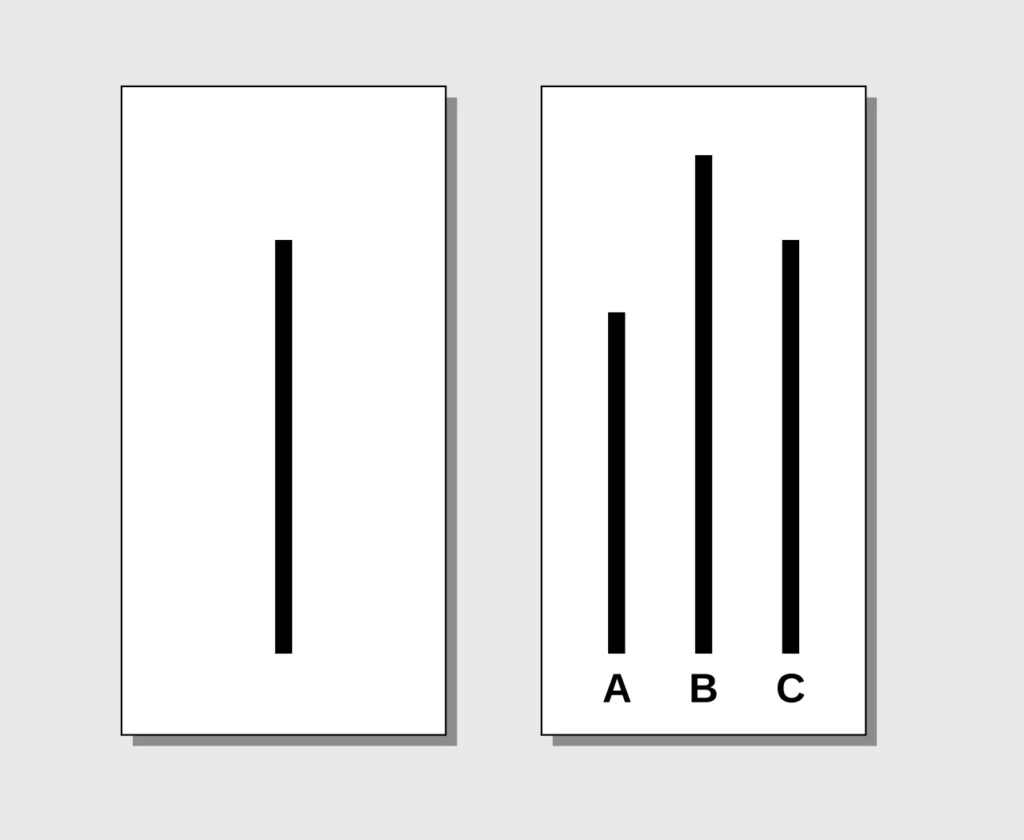
But there was a trap. Everyone in the group apart from the actual subject (all of them actors) deliberately gave the wrong answer. The result: about three-quarters of the subjects denied what their own eyes saw, at least once, and went along with the crowd. When done alone, the error rate was below 1%; under group pressure, it shot up to 32%. What the majority called “true” overrode even the individual’s reality.
So the majority isn’t the measure of truth. Never has been…
What are we actually doing when we decide?
This is where it gets really interesting. Because the majority being wrong isn’t a matter of mathematics. It’s about how each individual making up that majority decides…
Let me give you a great example from Malcolm Gladwell’s Blink. In the 1980s, the Getty Museum paid 7 million dollars for what was said to be an ancient Greek statue, a “kouros”. The statue was examined in laboratories for months. Geologists measured the age of the minerals on its surface. Documents were verified. All scientific evidence said the statue was genuine. Then a few art historians visited the museum, and within seconds of looking at the statue, they sensed something was wrong. They couldn’t even articulate it; they said vague things like “it looks too fresh”. They were right. The statue was a forgery…
Intuition had produced a faster and more accurate result than months of analysis.
But Gladwell also gives the opposite example in the same book: in 1999, the New York police shot Amadou Diallo with 41 bullets. Four officers assessed a young man arriving home in the middle of the night, within seconds. They concluded he was armed. But the man wasn’t armed. What he was holding wasn’t a gun, it was a wallet. Intuition kicked in here too; but this time it ended in a killing.
So intuition sometimes saves us, sometimes kills. Where does the difference come from?
Daniel Kahneman explains this very clearly in his book Thinking, Fast and Slow. Two systems work in our brain: System 1 is fast, automatic, and intuitive. System 2 is slow, analytical, and costly. We make almost all our daily decisions using System 1, because using System 2 is exhausting and effortful. Our brain is a lazy organ; it tries to take shortcuts at every opportunity.
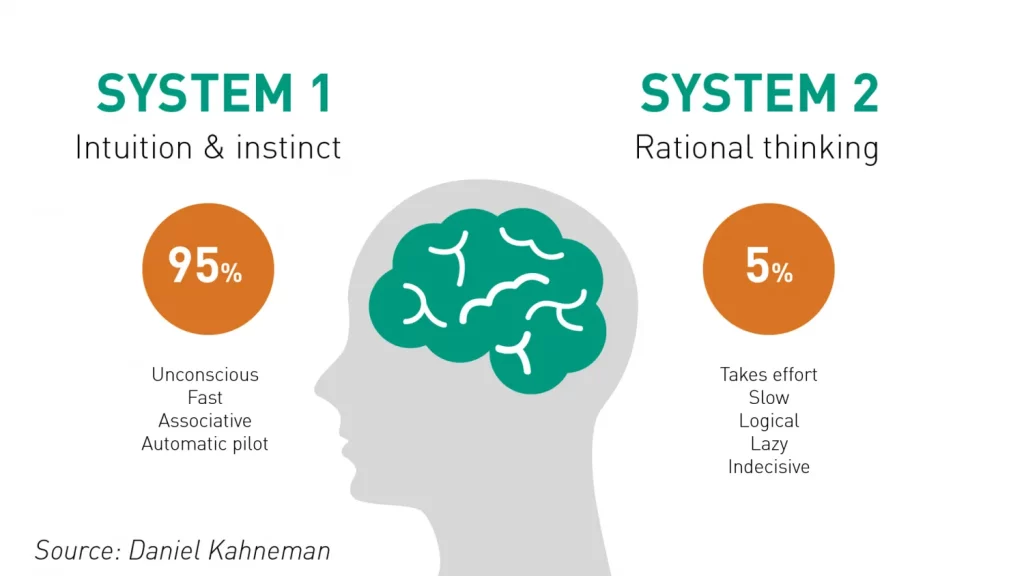
Welch’s 10/10/10 rule is essentially a System 2 trick. It forcibly pulls us away from instant reaction and pushes us to think. But we can’t do this for every decision. We can’t, and we don’t.
Dan Ariely captures exactly this point in his book Predictably Irrational. According to him, people make irrational decisions, but they do so in predictable ways. This makes them possible to manipulate. Because if a system errs randomly, you can’t game it. But if it errs the same way every time, you can turn that error into an industry. That’s exactly what advertising has been doing for nearly a century.
Also see: Can Irrational Human Behaviour Be Explained by Quantum Physics?
Coca-Cola’s 1985 “New Coke” disaster gives the same lesson. The company conducted blind taste tests on thousands of people. Pepsi won every time. So Coca-Cola changed its formula. The result was nothing like they expected: consumers revolted, and the company had to bring back the original formula 79 days later. Because preferring a sip of Pepsi is one thing; buying a can of Coca-Cola is another. The data was correct, but it was answering the wrong question. The “preference” of the majority had been misread. That alone is a summary of how much we should trust the idea of the majority…
What happens at the ballot box?
When we take all these findings to the ballot box, the myth of the “informed vote” reveals just how shaky its foundations are. Tom Stafford’s 2015 piece in BBC Future, “The Dark Psychology of Voting“, offers some uncomfortable data on the subject.
According to Stafford, what candidates actually say has very little effect on voter decisions. Instead, how the candidate looks, how they speak, how they stand, even how they smell is far more decisive. Even more interesting: when people like both candidates, their inclination to go to the polls drops. But if they hate one of the candidates, they rush to vote. So what gets us to the polls is, more often than not, hatred and disgust rather than affection. We can now better understand why politicians constantly attack their rivals.
Speaking of disgust: research shows that disgust responses correlate with political tendencies. When there’s a bad smell in a room, subjects have been observed to behave with temporarily more distance towards minority groups. In the 2008 US presidential election, voters’ decisions were also found to be influenced more by candidates’ ethnic backgrounds than by what they actually said.
Also see: The Impact of the Senses in Digital Marketing and the Role of Music
So even in the moment when you think you’re voting “rationally” at the ballot box, your decision may have already been made. Made by a cocktail of smells, facial features, tones of voice, and body language.
Then there’s the “information cascade” effect. One person feels uncomfortable with a candidate’s appearance and says so; a second person is influenced; a third agrees. After a while, you carry inside you not the opinion you would have formed on your own, but the collective sentiment that has formed around you. And you still call this “my own choice”.
The examples I gave at the start of this article, voting for the party that curses terrorists the loudest, finding the candidate who plays guitar “definitely worth voting for”, are exactly this. Decisions made through momentary emotional triggers, but registered in our minds as “informed choices”. And these decisions don’t stay individual; the same kinds of decisions, made by millions, come together to determine the fate of a country.
As I mentioned in my earlier article, Is Free Will an Illusion in the Digital World?, the idea of “deciding with free will” isn’t as innocent as we think.
Think for a moment about why you voted for the candidate you chose in the last election. If you say “because I liked their policies”, where did you learn about those policies? Did you read the candidate’s manifesto, or did you hear something someone else said about them? If you say “I trusted their character”, what did you base that trust on? Their face, their tone of voice, their social media posts? If you say “the other one was worse”, from which sources did you gather that “worse” image?
It’s not easy to answer these questions honestly. Because the answers often draw the outer boundary of what we call “my own decision”.
AI and algorithms…
So here’s where we stand: individuals decide emotionally, majorities get it wrong. Our intuitions can save or kill. System 1 almost always overrides System 2. And the whole process is wide open to external manipulation.
At this point, you could say “since people are so unreliable, let’s trust algorithms”. Because an algorithm doesn’t get caught up in emotions. It doesn’t get tired. It doesn’t have prejudices. It works with pure data.
But every word of that sentence is wrong.
The Cambridge Analytica scandal showed this most clearly. The company gained access to the data of 87 million people through Facebook (when the scandal first broke, this figure was reported as 50 million, then revised). It used this data to build psychographic profiles. Then it showed each voter personalised political ads that touched exactly their emotional triggers. The algorithm knew your weak points better than you did, and was pressing on them precisely.
This is the industrial-scale version of the “bad smell influencing the voter” experiment Stafford mentioned in his BBC piece. The only difference: there’s no need for a smell anymore. The algorithm finds the content that triggers you and puts it in front of you.
An example from the legal system is even more disturbing. In some US states, an algorithm called COMPAS calculated the risk of defendants re-offending. Judges took this score into account in sentencing decisions. ProPublica’s 2016 investigation revealed that the algorithm systematically rated black defendants as higher risk than white defendants. When you actually looked at re-offending rates, this prediction turned out to be wrong.

The algorithm wasn’t emotional, but it was prejudiced. Because the data it was fed was prejudiced. Worse, it legitimised that prejudice by wearing the appearance of “objective calculation”. A judge can’t say “let me sentence black people more harshly”. But an algorithm produces an output, and the judge takes it into account. What you get is a sort of laundered, sterilised prejudice with a “science” badge on it. This is more dangerous than naked prejudice, because it appears to be beyond contestation.
The common thread across all the examples we’ve discussed so far is that algorithms affect us, and we’re not aware of it. The voter targeted by Cambridge Analytica didn’t know they were being shown a personalised advert. The defendant judged by COMPAS didn’t see a score being generated about them. But in the past few years, something new has entered our lives: we now let artificial intelligence make decisions for us, willingly, with our consent.
We can ask ChatGPT far more personal questions now: “Which of these two job offers should I accept?”, “I had a fight with my partner, what should I do?”, “Which university should I go to?”, “Should I marry this person?”, “Should I do a PhD?”… We hear about these kinds of conversations every day. What’s more, people often find the answer given by AI more reliable than the answer given by their closest friends. Because it sounds “objective”. Because it sounds “knowledgeable”. Because it doesn’t argue, doesn’t get angry, doesn’t judge.
But the answer an AI model gives is essentially an average of the millions of texts it was trained on. So what it really tells you is “what the written sources say about this”, repackaged nicely. But the tone is so confident, the language so polished, that you perceive it as “an impartial expert opinion”. Just like in Welch’s 10/10/10 rule, when you try to predict the “you in 10 years”, you’re now drawing not just from your past consumption habits but from a probability distribution served to you by a language model. The decision looks like yours. But the one drawing the frame is a model running on some company’s servers.
Let’s bring these examples down to everyday life. The hundreds of small decisions you make from the moment you wake up to the moment you go to bed are now, directly or indirectly, shaped by algorithms:
- Which news you read is determined by the ranking in your social media feed.
- What you have for dinner is decided by a recommendation system that feeds on your previous click.
- Which video you watch is selected by YouTube’s video recommendation algorithm.
- Which song you listen to is determined by Spotify.
- Which candidate seems “sincere” and which one “off-putting” is shaped by what content shows up on your social media.
- When you search for a restaurant, Google ranks which one is “good”.
- Even who you’ll meet (via dating apps) is determined by a mathematical formula.
You could go on, but that’s enough for now. The point is this: behind every decision you think you’ve made through free will, there’s a system that has already drawn the frame for that decision. You’re choosing from a menu. But who prepared the menu?
What’s more, the system learns alongside you. What you click determines what you’ll be shown next. What you’re shown determines what you’ll click. It’s a closed loop, and a person caught inside it not only can’t see they’ve left the loop, they can hardly see the loop exists at all. Because everything they see is calibrated to a version of themselves “who thinks like them”.
Let’s go back to Welch’s 10/10/10 rule. Welch told us to ask ourselves “how will I feel 10 minutes, 10 months, 10 years from now?”. Sensible? Yes. But when you ask yourself this question today, all three answers come from a mind already shaped by algorithms. The reference points you use to imagine “the you in 10 years” (success, happiness, a decent life, etc.) were formed by content you’ve been exposed to for years.
So the 10/10/10 rule is still valuable. But it’s no longer enough on its own.
Kahneman’s System 1 / System 2 distinction also falls short today. Because there are no longer two systems but three: System 1 (intuition), System 2 (analysis), and a System 0 that kicks in before either of them. System 0 is the algorithmic infrastructure that filters your options for you, draws the frame, and even decides what you’ll think about, before you’ve even started thinking. System 0 is invisible and silent. Sometimes it picks the headline of the news for you; sometimes you ask it directly, “what should I do?”. In both cases, it’s the one drawing the frame.
Conclusion
I’d love to end this article on an optimistic note. I can’t. Because there’s no easy solution, and anyone who says there is, is either a fraud or selling something (or both).
Welch’s 10/10/10 rule is still valuable. But it’s no longer a three-question rule; it should be a four-question one:
- How will I feel 10 minutes from now?
- How will I feel 10 months from now?
- How will I feel 10 years from now?
- Who prepared this list of options?
The last question has become more important than the first three. Because you can’t find the right answer to the wrong question. What algorithms do isn’t to give you wrong answers; it’s to ask you pre-selected questions.
There are a few things you can do at the individual level. Wait 10 minutes before reacting angrily to a piece of news. Ask whether that anger really belongs to you. Before voting for a candidate, go beyond the feeling of “this person seems good to me” and think about what consequences which policies will carry. Before granting permission to an app, ask which of your future decisions this permission will shape. Read sources that will make you uncomfortable, to test your own thinking. The algorithm won’t do this for you, because its job is not to make you uncomfortable. And when you consult an AI on something, read its answer not as an expert opinion, but as a starting point.
The real point is that accepting our will isn’t entirely free shouldn’t mean giving up on our will. On the contrary, the decision a person makes within the limits they know is far more conscious than the decision made by someone who thinks they have no limits.
The Athenian majority who killed Socrates, the British who Googled Brexit after the fact, the experimental subjects who hardened against minorities in a foul-smelling room, the voters targeted by Cambridge Analytica, the people angry this morning at the headline an algorithm picked for them: they all had one thing in common. They all believed they made their own decision.
The real question is: blue or red? Is the pill you chose really your own choice? Or is it something else that leaves you with the feeling that it belongs to you?
The answer won’t always be clear. But just asking the question is far better than not asking at all…
Resources and further reading:
- 10-10-10: A Life-Transforming Idea, Suzy Welch (Book)
- Blink: The Power of Thinking Without Thinking, Malcolm Gladwell (Book)
- Thinking, Fast and Slow, Daniel Kahneman (Book)
- Predictably Irrational, Dan Ariely (Book)
- Democracy in America (De la Démocratie en Amérique), Alexis de Tocqueville (Book)
- “Socrates“, Stanford Encyclopedia of Philosophy
- “The Dark Psychology of Voting“, Tom Stafford, BBC Future
- “The British are frantically Googling what the E.U. is, hours after voting to leave it“, Brian Fung, The Washington Post
- “Revealed: 50 million Facebook profiles harvested for Cambridge Analytica“, Carole Cadwalladr & Emma Graham-Harrison, The Guardian
- “Machine Bias“, Julia Angwin, Jeff Larson, Surya Mattu & Lauren Kirchner, ProPublica